Zeoform board that has swollen after a leak can often recover if it dries slowly and evenly within about 48 hours. If it has warped, delaminated or stayed above 16% moisture after a week of drying, repair will not hold and the affected panels should be replaced.
On this page
- Quick recap
- What zeoform board swelling after a bathroom leak looks like
- How to tell if swelling is repairable or needs replacement
- Drying zeoform board properly so it can recover
- When replacement is the right call - and what it involves
- Preventing leaks and swelling in future bathroom installations
- Zeoform in an eco-materials bathroom: is it still a sensible choice?
- Quick questions
Part of our guide on identifying low voc paints
Quick facts
- Safe moisture reading
- Below 16% in timber-based board
- Action threshold
- Above 20% means wetting is active
- Drying window
- Allow 3 to 7 days minimum
- Sanding depth
- Light swelling only, 1 mm or less
- Wall gap needed
- Sealed edges plus 100 mm skirt clearance
- Bathroom humidity
- Keep below 65% with extraction
Quick recap
- Check swelling with three tests: flatness, surface integrity and a moisture meter reading.
- Panels still above 16% moisture content after a week of drying usually need replacing.
- Dry slowly with cross-ventilation - forced heat can cause zeoform to crack as it shrinks.
- Sand-and-seal works only for light surface swelling on undamaged panels.
- A sealed, ventilated bathroom stops the leak-swell cycle recurring.
What zeoform board swelling after a bathroom leak looks like
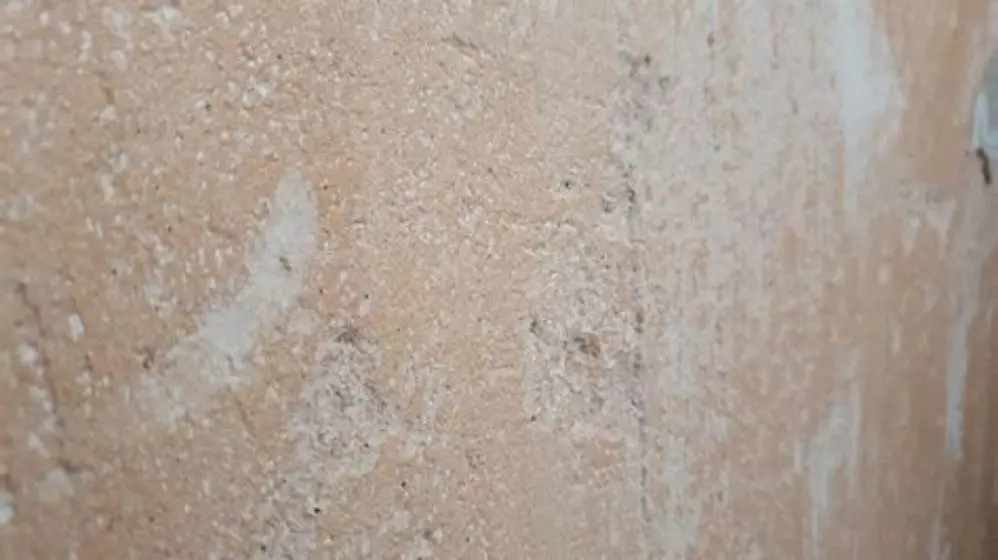
Zeoform is a cellulose-based board made from bound plant fibre, which means it behaves differently from chipboard or MDF when water gets in. The first sign is usually a raised, blistered patch rather than a soft crumble. The surface may feel firm but look inflated, a bit like paper that has been pressed against a damp wall. Edges are the weak point: where a cut edge has soaked, you will see the layers puff out and the board can grow a few millimetres thicker than its neighbours.
Run a straight edge, such as a spirit level or a length of timber, across the affected panel. Genuine swelling shows as a bump along that line or a panel standing proud of the sheets beside it. Compare the sheet with one in a dry part of the house - zeoform can swell by 2 to 4 mm in thickness once saturated, and that difference is easy to feel with your palm.
Discolouration tells you how long the water has been there. A pale, recently wet patch with no staining suggests a fresh leak from a split pipe or a failed silicone bead. Dark rings, grey streaks or a musty smell point to water sitting for weeks, which raises the chance of mould behind the panel. Press the swollen area gently: it should stay firm. If it feels spongy or the fibre crumbles under your thumb, the binding between fibres has broken down and drying alone will not restore strength.
- Raised blister or bulge you can feel with a straight edge
- Puffed, layered edges where the leak ran down a cut line
- Panel 2-4 mm thicker than adjacent dry sheets
- Pale damp patch (fresh leak) versus grey or dark staining (long-standing)
- Spongy feel or crumbling fibre means the board has lost integrity
How to tell if swelling is repairable or needs replacement
The honest answer comes from a moisture meter. Zeoform, like other cellulose boards, should sit around 10 to 13% moisture content in a normal UK bathroom. A pin-type meter with a timber scale is the right tool here - press the pins into the swollen area and into a dry panel for comparison. Any reading above 20% means the leak is either still active or the board is holding water; below 16% after a full week of drying is the usual threshold for calling a panel salvageable. There is more on is mgo board fire rating reliable for internal linings in a separate guide.
Next, judge the shape. If the board has swollen but stayed flat and attached, drying and re-sealing can work. If it has cupped, bowed away from its fixings, or pulled a fastener loose, it has moved permanently and will never sit flush again. Delamination at the edges - visible separation of layers more than about 1 mm deep - is also a point of no return, because sanded or filled edges soak up humidity again within weeks.
Trace the source. A one-off splash from a leaking tap trap behaves completely differently from a supply pipe dripping into a wall cavity for months. Long-term hidden leaks wet the timber studs and the back face of the board, so even a panel that looks fine from the front may be compromised. If the meter reads high on the stud behind the swollen panel, treat the whole bay as a replacement job, and get a plumber to confirm the leak is stopped before you buy anything.
- Meter-check the swollen area and a dry reference panel on the timber scale.
- Above 20%: find and stop the water source before judging the board.
- Dry for a full week with the bathroom well ventilated, then re-test.
- Below 16% and still flat: repair by drying, sanding and sealing.
- Still high, warped, cupped or delaminated more than 1 mm: replace the panel.
| Finding | What it means | Action |
|---|---|---|
| Meter below 16% after a week | Board has dried out | Sand light swelling and reseal |
| Meter above 20% after a week | Water still trapped or leak active | Trace source, dry longer or replace |
| Flat but puffed surface | Swelling only, bonds intact | Repairable |
| Cupped or pulled from fixings | Permanent movement | Replace |
| Edges delaminated over 1 mm | Fibre bonds broken | Replace |
| High reading on wall studs | Hidden wetting behind board | Replace panel and dry the cavity |

Wood Moisture Meter - Digital Moisture Detector Moisture Tester, Pin-Type
Pushes its pins into your swollen zeoform board and reads out the moisture content on a wood scale spanning 6%-60%, so you can see whether you're sitting near the 16% dry point or already past 20% where replacement wins.
Drying zeoform board properly so it can recover
Drying is where most people lose salvageable panels. Cellulose board that dries fast and unevenly shrinks on the surface while staying wet inside, which cracks the face and locks in the warp. The right approach is slow and steady: open the window, run the extractor fan, and let cross-ventilation pull moisture out over three to seven days. A dehumidifier on a low setting in a closed bathroom speeds this up safely, but keep direct heaters and heat guns away from the board. If that sounds like your situation, read up on plaster mix and drying for humid rooms next.
Remove anything trapping moisture while the panel dries. Skirting boards in front of the swollen area, silicone beads over the leak path, and any furniture pushed against the wall all hold damp against the fibre. If water ran behind a bath panel or shower enclosure, take the trim off so the edge can breathe. Wipe standing water off the surface within the first day rather than letting it soak deeper.
Check progress with the meter every couple of days. Readings should fall steadily; a number that stalls around 18-20% usually means water is trapped in the cavity behind the panel rather than in the board itself. At that point drill a discreet ventilation hole near the skirting line, or lift a section of board, so the wall void can dry. Once readings sit below 16% and stable for two consecutive days, the panel is dry and you can move to cosmetic repair.
Cosmetic repair for a recovered panel is simple. Sand any raised patch lightly - no deeper than about 1 mm - with fine paper, dust it off, and seal with a breathable water-based sealant or the manufacturer's recommended coating. Never fill a swollen patch with rigid filler before the board is fully dry; trapped moisture will blister the patch off within weeks. For the detail, see our notes on clay render cracking on old lime plaster walls.
- Dry over 3-7 days with cross-ventilation or a low-setting dehumidifier
- No heat guns or direct heaters - fast drying cracks and warps the face
- Remove skirting, trims and silicone over the wet path so edges breathe
- A stalled 18-20% reading means water is trapped in the wall cavity
- Sand max 1 mm once dry, then seal with a breathable coating
When replacement is the right call - and what it involves
Replacement is not a failure of zeoform as a material; it is the honest outcome when bonds have broken or the wetting was long-term. The good news from an eco-materials standpoint is that cellulose board is compostable and far less problematic to dispose of than resin-soaked MDF, and replacement sheets are relatively low-carbon compared with cement or plastic-based alternatives. Cut out affected panels with the fixings, inspect the studs behind, and let any wet timber dry to below 16% on the meter before re-sheeting.
Measure the bay before ordering. Zeoform sheet is commonly stocked in 2400 by 1200 mm panels in thicknesses from 6 to 25 mm, so a single sheet usually covers a full bathroom wall bay. Match the original thickness exactly - stepping up to a thicker sheet against adjacent panels creates a lip that collects water. Order a sample or confirm density if your board is load-bearing, since different densities behave differently under screws and brackets.
Fit with movement in mind. Leave a 3-5 mm expansion gap at floor level and where panels meet, hidden behind skirting or trim, because bathrooms cycle between humid and dry every day. Seal every cut edge before fixing - unsealed edges are how water found this panel in the first place. Use corrosion-resistant fixings, and once the panel is up, run a continuous bead of mould-resistant silicone at every junction with the bath, shower tray or tiles. Tiled over zeoform needs a waterproof membrane behind the tiles rather than relying on grout alone. We cover how sealing affects plywood offgassing in its own article.
- Fully dries and seals the wall cavity
- Removes hidden mould risk
- Cellulose board is compostable waste
- Single sheet usually covers a bay
- Cost of a new sheet and fixings
- Waiting for studs to dry below 16%
- Skirting and trims disturbed
Preventing leaks and swelling in future bathroom installations
Most zeoform swelling in bathrooms traces back to three failures: a worn silicone bead, a slow trap or supply leak, and condensation with nowhere to go. Replacing silicone every few years costs little and prevents the slow seep that does the real damage. Check under the bath panel and behind the WC twice a year with a torch - a faint tide line on the board edge is worth acting on long before a bulge appears.
Ventilation matters as much as plumbing. UK building regulations require extraction in new bathrooms, and a fan rated to run with a humidistat or overrun timer keeps humidity below the roughly 65% level at which cellulose boards start absorbing moisture from the air alone. Wipe condensation off window reveals and external walls each morning in winter; zeoform panels on cold exterior walls benefit from a small air gap or an insulating lining behind them.
Detailing at the edges does the rest. Seal every cut edge at installation, keep boards clear of the floor on a moisture-resistant barrier, and use a waterproof membrane behind any tiled zone. Where zeoform is used near a shower, specify it as a backing board within a sealed system rather than as the wet-face surface itself. These choices keep a genuinely sustainable material doing its job for decades instead of one leak-cycle. Before you commit to anything, it is worth looking at hot lime mortar setting time in freezing weather.
- Renew silicone beads every 2-3 years, especially at bath and tray edges
- Torch-check behind bath panels and the WC twice a year
- Humidistat or overrun extractor to hold humidity under 65%
- Seal all cut edges and leave a 3-5 mm expansion gap at the floor
- Membrane behind tiles rather than relying on grout
Zeoform in an eco-materials bathroom: is it still a sensible choice?
A swollen panel after one leak does not disqualify zeoform from green-home projects. Its strengths hold: it is made from bound cellulose fibre with no formaldehyde resins, it is low in embodied carbon compared with cementitious backer boards, and offcuts can be composted. The trade-off is moisture sensitivity, which means it has to be specified the way timber is - sealed, ventilated and kept out of standing water - rather than the way plastic boards are.
For most UK bathrooms the sensible pattern is zeoform or similar cellulose board on dry wall zones, with a fully waterproofed system behind tiles in wet zones. That plays to the material's strengths, keeps EPC-relevant work like insulation upgrades compatible, and avoids the all-or-nothing risk of one material everywhere. Pair it with good extraction and you get a healthier bathroom with a lower environmental footprint than chipboard-and-plastic equivalents.
If your priority is grant-funded retrofit work, note that moisture-sensitive boards interact with insulation and ventilation decisions. Sealing a bathroom tightly while adding insulation without extraction is exactly how humidity problems start, so plan ventilation alongside any Warm Homes or ECO4-funded measures rather than after them.
- Low embodied carbon versus cement or plastic boards
- No formaldehyde resins
- Compostable offcuts and waste
- Works well in dry zones with sealing
- Moisture-sensitive at edges
- Needs disciplined detailing in wet zones
- Requires good extraction to stay stable
Zeoform board can survive a bathroom leak if caught early and dried slowly, but once it warps or delaminates, replacement is the only reliable fix.
Quick questions
Will zeoform board shrink back to its original size once dry?
Partly, if it dries slowly and evenly. Surface swelling often reduces to a faint raised patch that can be sanded flat, but bulk expansion of 2 mm or more rarely disappears completely, so expect some sanding or a slight thickness difference.
Can I paint over a swollen zeoform panel?
Only after it is fully dry and stable - two meter readings below 16% on consecutive days. Sand the raised area lightly, seal it, then paint. Painting over damp board traps moisture and the paint will blister.
How long should I dry a zeoform panel before deciding?
Give it three to seven days of cross-ventilation, or longer if readings stay high. A stalled reading after a week usually means water is trapped in the wall cavity, not the board itself.
Is swollen zeoform board likely to grow mould?
Cellulose supports mould growth if it stays damp, so any panel wet for more than a few days should be checked behind as well as in front. Musty smell or grey staining means inspect the cavity before re-sealing.
Is zeoform board suitable for shower enclosures?
As the visible wet-face surface, no. Use it on dry wall zones and fit a waterproof membrane system behind tiles in shower zones, with every edge sealed.