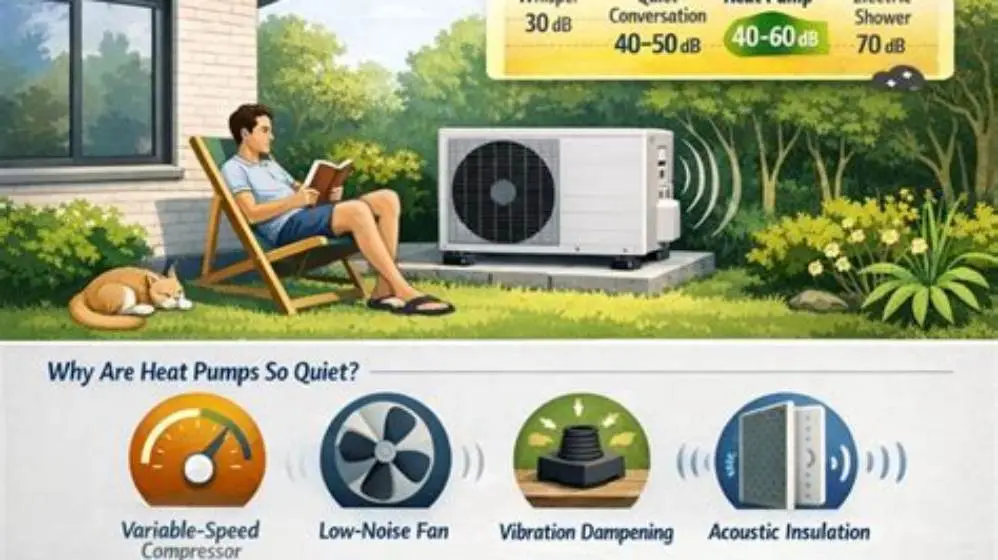
Air to air heat pump noise levels in urban homes sit near 45-60 dB(A) at 1m per datasheet at rated load, hemispherical free field. Levels fall to low 30s dB(A) at 4-6m with distance loss. You pass on a terrace only if the level at the nearest neighbour habitable window stays at or below 42 dB(A).
On this page
- Quick recap
- Check the brochure figure first: sound power versus sound pressure at 1m
- Estimate the level at the fence and the neighbour window
- Pass the 42 dB test at the nearest habitable window
- Compare outdoor and indoor unit levels and night low-load operation
- How to compare air to air heat pump noise levels in urban homes on the same basis
- Make it fit on your plot: a terrace and semi checklist
- Quick questions
Part of our guide on optimizing home heating costs
Quick facts
- Typical at 1m
- 45-52 dB(A) quiet, 55-60 dB(A) loud
- Limit at window
- 42 dB(A) MCS permitted development
- Drop per doubling
- About 6 dB outdoors
- Night mode cut
- Often 5-10 dB lower
- Indoor unit
- 19-32 dB(A) at 1m
- Urban background
- Often 40-55 dB(A) daytime
Quick recap
- The brochure
1mfigure is sound pressure, not sound power: compare like for like. - Sound falls about 6 dB each time you double distance outdoors, less if walls reflect it.
- Permitted development passes only at 42 dB at the nearest neighbour habitable window.
- Night and low-load modes often cut 5-10 dB, but add a hum that carries further.
Check the brochure figure first: sound power versus sound pressure at 1m
Brochures quote either sound power or sound pressure. Sound power is the total energy the unit puts out. It is measured in dB(A) and sits around 55-65 dB(A) for small air-to-air outdoor units. Sound pressure is what you hear at a point. It depends on distance, direction and reflections. One unit can have both numbers and they differ by 7-11 dB.
Look for the small print. A figure labelled LwA or sound power level holds under lab conditions. A figure labelled LpA at 1m holds at one metre from the front panel, usually in free field. Free field means no walls nearby. Your terrace has walls, fences and a yard that bounce sound. Real levels at the same distance read higher.
Do this before you compare. Find both numbers for each model. If you only have sound power, subtract about 8 dB to estimate sound pressure at 1m in free field. If you only have sound pressure, ask for sound power. Comparison fails when you mix them. That mistake makes a loud unit look quiet.
Estimate the level at the fence and the neighbour window
Sound drops with distance, but not as fast as people hope. Outdoors with no reflections it falls about 6 dB each time you double distance. So 50 dB(A) at 1m becomes about 44 dB at 2m, 38 dB at 4m, 32 dB at 8m. Walls, fences and hard patios reduce that drop. A unit tucked in a corner by two walls can read 3-6 dB higher than free field. We go through are smaller heat-pumps more efficient step by step elsewhere on the site.
Measure from the centre of the fan grille, not the wall bracket. Stretch a tape to the boundary, then to the nearest neighbour window that can open. Use the shorter of the two for the MCS test, but check both. Terraces often have a neighbour window 2-4 metres away. Semis often have 3-6 metres. One metre of extra setback matters more than picking a slightly quieter model.
Add a small correction for reflections. If the unit faces a wall within 1.5m, add 2-3 dB. If it sits in a narrow side return with walls on two sides, add 4-6 dB. Subtract nothing for fences. A timber fence leaks sound. Do not rely on it. Use the corrected figure as your estimate at the window before background is counted.
- Find the sound pressure at
1mindB(A)from the datasheet, or estimate it from sound power minus 8 dB. - Measure distance in metres from fan centre to the nearest neighbour habitable window. Note any wall within 1.5m.
- Apply distance drop: minus 6 dB per doubling of distance from 1m (e.g., 2m -6 dB, 4m -12 dB, 8m -18 dB).
- Add reflection correction: +3 dB for one close wall, +5 dB for two walls or a tight alcove.
- Compare the result to 42 dB. If it sits above, move the unit, add distance, or pick a lower-noise model.

CRY2831 IEC 61672-1:2013 Sound Level Meter Class 2
Lets you estimate your heat-pump noise at the fence and neighbour window with Type 2 A-weighted readings from 29 to 138 dB, slow/fast response and factory calibration certificate.
Pass the 42 dB test at the nearest habitable window
Permitted development in England uses the MCS planning standard MIS 3005. It sets 42 dB(A) at the nearest habitable room window of a neighbour. Habitable means bedroom, living room, study or kitchen, not a bathroom or hallway. The test uses the unit at full rated output, plus corrections for tonality and intermittency. You must pass without relying on closed windows. There is more on why air-side metering lacks MID approval in a separate guide.
The assessment is not a one-off meter reading on install day. It is a calculation done before install. Installers use the manufacturer sound power, distance, directivity and any screening. Screening by a fence or hedge counts for little unless it is solid masonry with no gaps. A brick outbuilding or the mass of your own house counts more. Background noise does not raise the limit. It stays at 42 dB.
If you cannot meet 42 dB by calculation, you need planning permission or a different location. Move the unit further from the window. Face the fan away from the neighbour. Raise it off the ground to miss the fence reflection. Choose a unit with a lower LwA or a true low-noise mode that holds at full load. Do not plan to argue that the street is already noisy.
Terraces and semis fail most often on distance, not on the unit itself. A typical 50 dB(A) at 1m passes at about 4-5m in free field. Add a side-return wall and you need 6-7m. Many terraces have only 2-3m to the neighbour window. That plot needs a very quiet unit or a rear-yard position with clear line of sight away from windows. The other half of this decision is brine loop leak test methods.
Compare outdoor and indoor unit levels and night low-load operation
Outdoor and indoor units live in different worlds. The outdoor unit does the noisy work. Its fan and compressor sit at 45-60 dB(A) at 1m. The indoor wall or floor unit is far quieter, usually 19-32 dB(A) at 1m on low fan. You will hear the indoor unit as air movement, not as a drone. Mount it on a solid wall and you avoid buzz.
Night mode changes the outdoor picture. Most air-to-air models cut fan speed and limit compressor power at night or in quiet mode. Expect a drop of 5-10 dB in sound pressure at 1m when that mode holds. That can turn a borderline 44 dB at the window into a pass at 36-39 dB. Check the fine print. Some modes only cut a few decibels or only at part load.
Low load brings a different problem. At mild temperatures the unit cycles or runs slow. The broadband roar falls, but a tonal hum or whine can stand out. Tones carry and annoy more than the dB(A) number suggests. MCS adds a tonal penalty for this reason. Listen to a running unit at low speed if you can. Stand at the boundary. A smooth whoosh masks better than a whine. If that sounds like your situation, read up on factors limiting geothermal adoption next.
Place the indoor unit with the same care. Avoid putting the indoor head on a bedroom party wall. Vibration travels. Use anti-vibration mounts outside and flexible feet. Keep pipe runs short and clipped with rubber-lined clips. A rattle at 2am reads louder than any datasheet number. Test it on a cold night before you sign off.
- night mode can save 5-10 dB at window
- indoor heads run near whisper on low fan
- tone penalty can add 3-6 dB in assessment
- tight side returns lift outdoor level
How to compare air to air heat pump noise levels in urban homes on the same basis
Air to air heat pump noise levels in urban homes look alike on paper until you fix the basis. Always compare sound power LwA to LwA, or sound pressure at 1m to sound pressure at 1m in the same field. Do not compare one brand power to another pressure. Ask for the full acoustic table. It lists LwA, LpA at 1m and 2m, and low-noise mode. One number hides the rest.
Background noise fools the ear, not the rule. A busy urban street sits at 45-55 dB(A) by day. Your unit at 38 dB at the window will hide in that. At 11pm the street can fall to 32-38 dB. The same unit now stands out. Neighbours hear it at night, not at noon. Complaints follow night audibility. The 42 dB limit already assumes quiet background, so do not add background to justify a louder unit. If that sounds like your situation, read up on saving energy with fresh air next.
Use a like-for-like check. Pick two models with similar heat output in kW. Note their LwA and their LpA at 1m. Estimate each at your measured distance with the same reflection add-on. The lower result wins on that plot, even if its 1m figure looked higher in free field. A unit that is 2 dB louder at 1m but less tonal can pass while a quieter whiny one fails.
- Get LwA and LpA at
1mfor both models: same load, same mode. - Estimate level at neighbour window with distance and wall corrections applied equally.
- Check low-noise mode figures at full load, not just at part load.
- Listen for tone: a pure hum adds a penalty in the MCS maths. Ask for tonal data.
| Model | Sound power LwA | Sound pressure at 1m | Estimated at window |
|---|---|---|---|
| Unit A — compact | 58 dB(A) | 50 dB(A) | 41 dB(A) — pass |
| Unit B — standard | 62 dB(A) | 54 dB(A) | 45 dB(A) — fail |
- same-distance maths beats brochure ranking
- reveals tonal and reflection penalties early
- needs accurate distance and wall notes
- spec sheets often hide low-load tone
Make it fit on your plot: a terrace and semi checklist
Start with the plot, not the catalogue. Sketch your house, the boundary and the neighbour windows. Mark the fan centre for two or three possible positions. Measure each distance with a tape. Note walls, alcoves and hard surfaces within 1.5m. Take a phone photo from the neighbour window back toward your wall. That view is what sound sees.
Run the numbers for each spot using the steps above. Aim for at least 2 dB under 42 dB to leave margin for install variation. If only one spot passes, protect it. Keep bins, bikes and planting clear of the airflow. Do not box the unit in with a slatted cover. Covers often lift noise by trapping and reflecting it, and they cut performance.
Fix the install details. Mount on anti-vibration feet or wall brackets with rubber isolators. Keep the unit level and square to the wall so the fan does not howl. Face the discharge away from the neighbour window and away from your own bedroom. Leave 300-500 mm clear around the unit for air and for service. Seal pipe holes with acoustic putty to stop indoor hum.
Check after install with a simple meter. Stand at the neighbour window height and run the unit on full heat, then on quiet mode. Note the dB(A) reading and whether you hear a tone. Log the time, wind and background. If you read above 42 dB, move the unit or add a solid masonry screen that breaks line of sight. A dense 200 mm block wall helps. A thin fence does not.
Quick questions
Is the 42 dB limit measured with windows open or closed?
The calculation assumes windows open for ventilation. It is assessed at one metre outside the nearest habitable room window. Closed windows do not count as mitigation for permitted development.
Does a fence or hedge cut the noise enough to pass?
A standard timber fence or hedge cuts very little, often 1-2 dB. A solid masonry wall with no gaps that fully breaks line of sight can cut 5-10 dB. Most plots need distance or a quieter unit, not a fence.
What distance do I need on a typical terrace?
A unit at 50 dB(A) at 1m needs about 4-5m in free field to hit 42 dB, and 6-7m if tucked beside a wall. Many terraces only have 2-3m, so you need a low-noise model and an open position.
Are indoor units noisy at night?
Indoor heads run at 19-32 dB(A) at 1m on low fan, similar to a quiet room. Mount on a solid wall, not a lightweight partition that shares a bedroom, and use low fan at night.
Can I use a phone app to check noise?
A phone gives a rough idea but not a legal figure. A calibrated Type 2 meter with dB(A) weighting is the right tool for a before-you-buy check and a post-install sanity check.