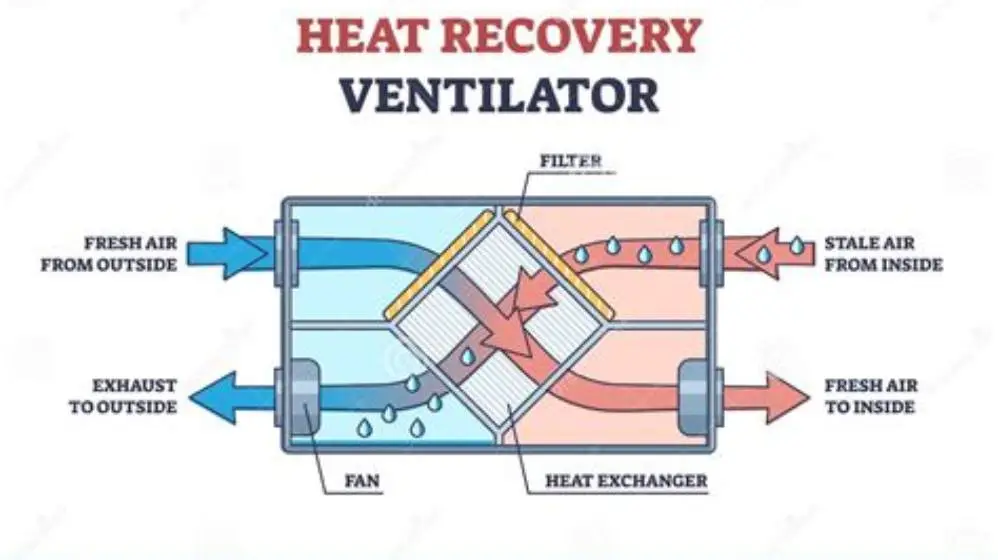
A heat recovery ventilator (HRV) exchanges indoor stale air with fresh outside air, recovering around 70-90% of the heat normally lost. This improves air quality and lowers heating costs in airtight UK homes.
On this page
- Quick recap
- Explain what a heat recovery ventilator is
- Why do you need a heat recovery ventilator in a modern UK home
- How to decide if a heat recovery ventilator fits your home
- What size and specifications should a heat recovery ventilator have
- How does a heat recovery ventilator work with heat pumps and EPC ratings
- How to maintain and check a heat recovery ventilator
- Quick questions
Part of our guide on what is a hybrid heat pump
Quick facts
- Heat recovery efficiency
- 70-90%
- Typical airflow rate
- 100-300 m³/h
- Main filter type
- G4 or F7
- Noise level range
- 20-40 dB
- Installation locations
- Loft, utility room
Quick recap
- HRVs recover 70-90% of heat from outgoing air.
- They prevent damp and mould by improving ventilation.
- HRVs are essential in modern low-energy homes.
- Sizing depends on house volume and occupancy.
- UK grants sometimes cover HRVs with heat pump installs.
Explain what a heat recovery ventilator is
A heat recovery ventilator (HRV) is a mechanical system that exchanges stale indoor air with fresh outside air, recovering heat from the outgoing air to warm the incoming air. It typically recovers 70-90% of heat that would be lost in traditional ventilation.
This system suits airtight homes common in the UK, where natural ventilation is minimal and indoor air quality suffers. The HRV maintains a healthy environment and reduces heating bills by limiting heat loss during ventilation.
The unit consists of two fans and a heat exchanger inside. One fan extracts used air while the other draws fresh air in. Heat transfers across the exchanger, warming fresh air without mixing contaminants.
Why do you need a heat recovery ventilator in a modern UK home
Modern UK homes are built airtight to save energy, reducing natural air leaks to below 1 air change per hour. This restricts airflow and can cause humidity, condensation, and mould growth without proper ventilation. It helps to understand monthly cost drop heat pump before going further.
Using an HRV prevents damp issues by controlling moisture levels while preserving heat, which a simple extractor fan or trickle vents cannot do efficiently. It also removes pollutants, cooking smells, and CO2, improving occupant comfort.
Without HRV, homeowners risk unhealthy air and higher heating bills due to the heat lost through opening windows or conventional extractors.
You’ll feel the need most when relative humidity stays above 60% for hours. That level lets mould grow on cold corners and window reveals. A well-set HRV holds living rooms at 40-60% RH through winter without opening windows. Trickle vents and single extract fans can’t do that. They dump warm air and pull in cold draughts. That’s the gap HRV fills. If that sounds like your situation, read up on are smaller heat-pumps more efficient next.
Test it with numbers you can check. A family of four adds about 8-10 litres of moisture a day from cooking, showers and breathing. Without steady ventilation CO2 climbs past 1,000 ppm by evening and rooms feel stuffy. An HRV running at 0.5 air changes per hour keeps CO2 near 800-900 ppm and RH in range. Check with a £20 hygrometer and CO2 meter. If either stays high, raise the fan speed.

AKSTEST CO2 Monitor Indoor
Lets you verify your heat recovery ventilator is actually ventilating by watching CO2 from 0 to 9999 ppm and humidity from 0 to 100% RH in real time with alerts at 1500 ppm.
How to decide if a heat recovery ventilator fits your home
Check your home's air tightness first. If your air permeability is below 5 m³/(h·m²) at 50 Pa (typical of new builds and retrofitted homes), an HRV is usually recommended.
Size the HRV to exchange the indoor air volume 0.3 to 0.5 times per hour. For example, a 120 m² home with 2.5 m ceilings has 300 m³ volume. It will need an HRV airflow of 90 to 150 m³/h to ventilate properly. Before you commit to anything, it is worth looking at heat pump or mini split comparison.
Consider occupancy: more people produce more moisture and CO2, increasing ventilation demand. The HRV’s airflow range must cover your household size.
Also, check if your heating system can integrate with an HRV for balanced airflow and controls.
- Measure or find your home's air permeability rating.
- Calculate indoor air volume (floor area × ceiling height).
- Multiply by 0.3 to 0.5 air changes per hour to find needed airflow (
m³/h). - Compare with HRV model airflow specs to select a good fit.
What size and specifications should a heat recovery ventilator have
Select an HRV with airflow capacity matching your ventilation needs: usually 100-300 m³/h for typical UK homes. Under-sizing leaves stale air buildup, over-sizing wastes electricity and costs more. If that sounds like your situation, read up on factors limiting geothermal adoption next.
Heat recovery efficiency should be at least 70%. Higher efficiencies up to 90% save more heating fuel but tend to cost more upfront.
Noise levels between 20 and 35 decibels at typical operation are comfortable for living spaces. Look for units with variable speed control for quieter running.
Filters in HRVs are usually G4 for dust and pollen, upgraded to F7 if occupants have allergies or live in polluted areas. We go through detect brine loop leaks underground step by step elsewhere on the site.
Ensure the unit fits your available installation space: lofts, utility rooms, or airing cupboards are common. Duct sizing also affects performance.
| Airflow (m³/h) | Heat recovery efficiency | Noise level (dB) | Filter type | Typical installation spot |
|---|---|---|---|---|
| 100-150 | 75-85% | 20-30 | G4 | Loft |
| 150-250 | 80-90% | 25-35 | G4/F7 | Utility room |
| 250-300 | 85-90% | 30-40 | F7 | Airing cupboard |
How does a heat recovery ventilator work with heat pumps and EPC ratings
Heat pumps supply low-temperature heat, so reducing heat loss via ventilation becomes more critical. An HRV complements a heat pump by recovering heat from exhaust air, maintaining efficient heating.
In EPC assessments, installing an HRV helps improve the ventilation score and can reduce heating demand, positively affecting the overall EPC band.
The Boiler Upgrade Scheme and ECO4 sometimes support HRV installation alongside heat pumps to meet whole-house retrofit goals. Check eligibility carefully as conditions apply.
An HRV’s balanced ventilation supports indoor comfort and moisture control, helping prevent condensation damage sometimes worsened by heat pump operation in winter.
Heat pumps run best at low flow temperatures of 35-45°C. That makes every kilowatt of heat loss count. An HRV that recovers 80% cuts ventilation heat loss from, say, 1.2 kW to 0.24 kW on a cold 0°C day with 150 m³/h airflow. Your heat pump then cycles less and keeps a steady COP near 3.0-3.5. Without recovery the same airflow forces the pump to work harder and rooms feel draughty.
For EPC, ventilation heat loss feeds into SAP. A balanced HRV with heat recovery above 75% and specific fan power below 1.0 W/(l/s) earns SAP credits that can lift you a few points. That can tip a high D to a low C in a tight new build. The check is the product datasheet and the commissioning certificate. Ask your assessor to log the HRV model and measured airflow. Missing paperwork means no credit.
How to maintain and check a heat recovery ventilator
Regularly replace or clean the filters every 3 to 6 months depending on usage and environment. Clogged filters reduce airflow and efficiency.
Inspect the heat exchanger annually. Some models have washable cores, others require replacement every 5-10 years.
Check for unusual noises or reduced airflow as signs of fan wear or duct blockages.
Test indoor air quality and humidity levels periodically to ensure the system works properly. A basic CO2 meter or humidity sensor helps spot ventilation issues.
Keep intake and exhaust grilles clear of debris and secure.
A clogged filter shows quickly. Airflow drops 20-30% and fan power rises from 25 watts to 40-50 watts as the unit strains. You’ll hear a higher hum and rooms turn stuffy. In a dusty street or near building work check filters monthly at first. City homes often need a change at 3 months, rural homes stretch to 6. Hold the filter to light. If you can’t see through it, swap it.
Once a year run a simple balance check. Tape a tissue to each supply and extract valve. Both should flutter the same. If one hangs limp, a duct has slipped or a grille is blocked. Also watch the frost protection light in winter. If it stays on for days, the intake may be icing or the drain is blocked. Clear the outside hood and check the condensate trap holds water. That keeps efficiency up.
- Turn off the HRV power before maintenance.
- Remove and clean or replace the filters.
- Use warm water or a vacuum to clean the heat exchanger, if washable.
- Inspect and clear ducts and grilles of blockages.
- Turn the system back on and measure airflow and noise.
Quick questions
What is the difference between an HRV and an MVHR system?
An HRV exchanges air and recovers heat but does not control humidity beyond ventilation. MVHR systems include humidity sensors and can adjust airflow for better moisture control. In UK homes, the terms are often used interchangeably.
Can I install a heat recovery ventilator myself?
Installation involves ductwork, electrical wiring, and balance testing. Most homeowners need a qualified installer to ensure correct setup, system balance, and compliance with building regulations.
Will an HRV increase my electricity bill?
HRVs use fans that typically consume 20-50 watts. The cost is offset by reduced heating demand from recovered heat, usually saving more energy than the fan uses.
Does an HRV work in winter and summer?
Yes. In winter, it recovers heat from outgoing air to warm incoming air. In summer, it provides fresh air without cooling the home excessively, reducing the need for air conditioning.
How do I know if my home qualifies for grants to install an HRV?
Grants like the Boiler Upgrade Scheme sometimes include HRVs when installed with heat pumps or whole-house retrofit. Check scheme terms on government websites and ask your installer.