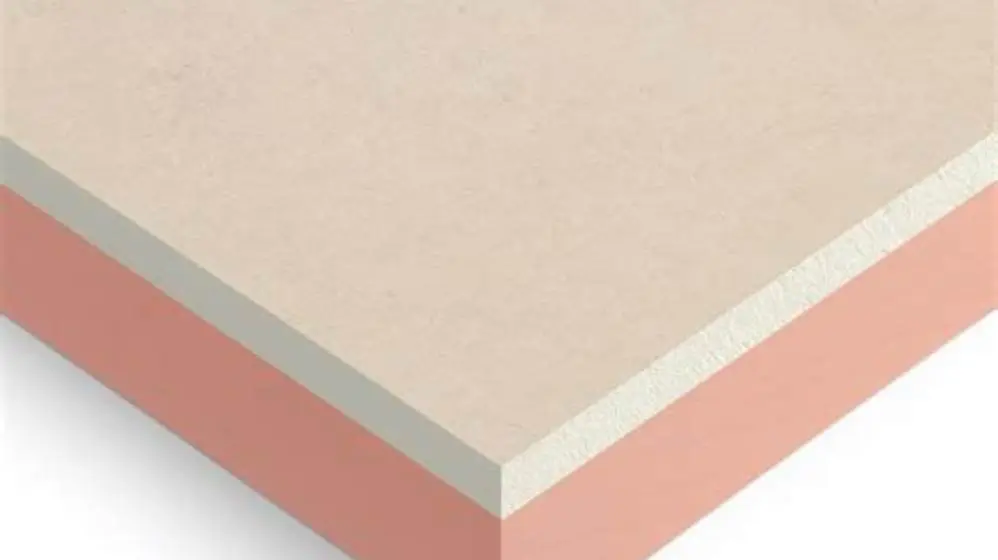
Insulated plasterboard costs roughly £13-15 per m² at 25mm PIR and climbs to about £30-34 per m² at 70mm. These are mid-2025 supply-only prices ex-VAT, drawn from Jewson, Travis Perkins and Selco branch quotes for Gyproc Thermaline, Kingspan K118 and Celotex PL4000 lines. On a solid brick wall, 50mm at around £21-24 per m² supply price is the usual sweet spot.
On this page
- Quick recap
- How much insulated plasterboard costs, thickness by thickness
- Sheet sizes, waste and the effective price per square metre
- What the quoted price leaves out
- How much U-value each thickness buys on a solid brick wall
- Insulated board against plain board over a separate insulation layer
- Where the board cannot go, and where the cheap stock comes from
- Quick questions
Part of our guide on how much does internal insulation cost
Quick facts
- 25mm board price
- about £13-15 per m² ex-VAT
- 50mm board price
- about £21-24 per m² ex-VAT
- 70mm board price
- about £30-34 per m² ex-VAT
- Standard sheet size
- 2400 x 1200mm, 2.88 m²
- PIR conductivity
- about 0.022 W/mK
- 50mm on solid wall
- U-value drops to roughly 0.37
- Payback sweet spot
- 50mm on solid walls
Quick recap
- Expect £13-15/m² at 25mm PIR, £21-24/m² at 50mm and £30-34/m² at 70mm, ex-VAT supply-only.
- Add 20% VAT if you are buying retail. Trade prices are quoted without it.
- Brand and product line shift the range: Kingspan K118 tracks 10-15% dearer than Celotex PL4000.
- On a solid 9-inch brick wall, 50mm takes the U-value from about 2.2 down to roughly 0.37.
- A 2400 x 1200 sheet covers 2.88 m². The 2400 x 900 size wastes less on stepped walls.
- Budget another £10-14/m² for skim coat, longer fixings and extended window reveals.
How much insulated plasterboard costs, thickness by thickness
The price of insulated plasterboard is set almost entirely by the PIR layer bonded to the back of the board. The plaster face costs the same whatever you buy. In mid-2025, merchants are quoting roughly £13-15 per m² ex-VAT for a 25mm board and around £30-34 per m² at 70mm. Those figures are supply-only prices from Jewson, Travis Perkins and Selco branches for Gyproc Thermaline, Kingspan K118 and Celotex PL4000 lines.
Brand and product line shift the range. Kingspan K118 typically tracks 10-15% dearer than Celotex PL4000 at the same thickness. Gyproc Thermaline sits in the middle. Regional variation of ±15% is normal, and merchants discount on volume orders of five pallets or more.
A standard 2400 x 1200mm sheet covers 2.88 m². That makes per-board prices easy to sanity-check. A 50mm sheet at £22 per m² should cost about £62-64. Anything wildly outside that is worth questioning. Trade merchants often quote per sheet, builders' merchants sometimes per m². Do the division before comparing two suppliers. Delivery on pallets of twelve sheets can swing the effective price by a couple of pounds per m² on a small order.
These are supply prices, not fitted prices. The merchant is quoting for boards on a pallet. Labour to fix, tape and skim the boards will typically add £25-40 per m² depending on region. The number of reveals and sockets also matters. We break down exactly what the quoted figure excludes further down this page. People in this spot often ask about 10kWh home battery installed cost as well.
| PIR thickness | Approx. £/m² ex-VAT | Approx. per 2.88 m² sheet |
|---|---|---|
| 25mm | £13-15 | £38-43 |
| 40mm | £17-20 | £49-58 |
| 50mm | £21-24 | £60-69 |
| 60mm | £25-28 | £72-81 |
| 70mm | £30-34 | £86-98 |
Sheet sizes, waste and the effective price per square metre
Two sizes dominate the shelves: 2400 x 1200mm and 2400 x 900mm. The 1200mm-wide board is cheaper per m² because it is the volume line every merchant stocks. It suits rooms with flat, unbroken walls. The 900mm board costs roughly 10-20% more per square metre for the same thickness. But it is lighter to carry through a terraced-house stairwell. It is also easier to cut around old properties that are never square.
Waste is where sheet size really bites. In a Victorian bay with a stepped window reveal, a 1200mm board that has to be notched can leave offcuts too small to use anywhere else. Effective coverage can drop from 2.88 m² to nearer 2.4 m². A 2400 x 900 sheet handles the same bay with a single cut. On a room with a stepped chimney breast, sizing boards to the geometry can claw back 5-10% of the order.
The practical rule is to measure the wall, sketch each sheet's position, and order the mix. Wide boards for the main runs, narrow boards for the awkward flanks. Then add a waste allowance of 8% on plain walls and 12-15% on anything with bays, piers or multiple reveals. There is more on how much does draught proofing cost in a separate guide.
| Sheet size | Coverage per sheet | Typical waste | Best suited to |
|---|---|---|---|
| 2400 x 1200mm | 2.88 m² | 8-10% | Long flat walls, new builds |
| 2400 x 900mm | 2.16 m² | 6-8% | Bays, chimney breasts, tight access |
What the quoted price leaves out
A per-m² board price is the top of a short ladder of extra costs. The omissions catch people out because they are all small individually. Skim coat and taping add around £8-12 per m² if you want a paint-ready finish. About half that if you accept tape-and-joint with a textured paint. Skipping the skim on living rooms is a false economy. In hallways and utility spaces it can be fine.
Fixings cost more than for plain board. A 50mm insulated board needs screws or fixings long enough to bite 25mm into the masonry beyond the insulation. That means roughly 100-135mm fixings at about £2-4 per m². Compare that with pennies for dot-and-dab adhesive on drywall alone. Add foil tape at junctions if the boards are foil-faced and butted.
The sneaky one is the perimeter. Insulating a wall pushes the plaster face 50-70mm into the room. Every window reveal, door lining, skirting and socket face needs extending. Reveal boards, extended backboxes and replacement skirting commonly add £3-6 per m² across the whole wall. Lost floor space is free to quantify but real to live with. For the detail, see our notes on smart thermostat installation ease.
- Skim coat and taping: £8-12 per m² for a paint-ready finish
- Long fixings or battens: £2-4 per m²
- Extended reveals, backboxes and skirting: £3-6 per m² across the wall
How much U-value each thickness buys on a solid brick wall
On a typical 215mm solid brick wall with a U-value around 2.2 W/m²K, PIR at 0.022 W/mK transforms the numbers fast. These figures assume no thermal bridging credit and standard internal/external surface resistances of 0.13 and 0.04 m²K/W. Real values will be worse where fixings or mortar joints bridge the insulation.
A 25mm board takes the wall to roughly 0.63. 50mm gets it to about 0.37. 70mm lands near 0.28. Each extra 25mm buys less than the one before. The wall's U-value falls as a curve rather than a straight line.
The bill follows the same curve. The first 50mm does most of the work. The marginal saving per pound spent peaks at the 50mm step for most homes. That gives the boundary the title asks for. Below about 40mm, on a solid wall heated by mains gas at ordinary tariffs, the board is a comfort fix. It warms the wall surface, kills condensation and makes the room feel warmer. But the energy saving rarely pays the board back in under 20 years. At 50-70mm, with a fitted cost around £50-70 per m² all-in, payback on a cold, previously uninsulated solid wall can come inside 12-15 years. We go through gas combi boiler lifespan and annual service cost uk step by step elsewhere on the site.
| Thickness | Resulting U-value |
|---|---|
| 25mm | ≈0.63 |
| 40mm | ≈0.44 |
| 50mm | ≈0.37 |
| 60mm | ≈0.32 |
| 70mm | ≈0.28 |
Insulated board against plain board over a separate insulation layer
The comparison that decides most jobs: buy a bonded insulated board, or buy plain plasterboard and fix a separate PIR sheet behind it. On supply cost, the bonded route usually wins at thin thicknesses. Manufacturers laminate at scale. Buying a 25mm PIR sheet and a 12.5mm board separately costs £10-15 plus £5-6 per m². That is clearly more than a bonded 25mm board at £13-15.
But the separate route has a counter-argument at the top end. Two separate sheets can be cross-fixed for a more robust mechanical connection. Individual PIR sheets are easier to cut tightly around pipework. If your wall is out of plumb by more than a few millimetres, a batten-and-insulate build-up handles the unevenness better than adhesive dabs ever will. There is also the damp argument: a fully bonded board put straight onto a cold, moisture-prone wall traps risk behind the plaster. A ventilated battened layer lets you inspect.
All-in, per m², with fixings and skim on both routes, the bonded board typically comes out £5-10 per m² cheaper on flat walls. The separate layer costs that premium for robustness and detailing.
| Measure | Bonded 50mm board | Plain board + separate 50mm PIR |
|---|---|---|
| Supply cost | £21-24/m² | £28-32/m² |
| Fixing method | Dabs or mechanical fixings | Battens or dabs plus screws |
| Total all-in | £50-65/m² | £58-75/m² |
| Handles uneven walls | Poorly | Well, if battened |
- Cheapest all-in route on flat walls
- One trade visit, faster to fit
- Thin build-up per millimetre
- Poor on walls out of plumb
- Hides damp if the wall is questionable
- Thick boards get heavy to handle
Where the board cannot go, and where the cheap stock comes from
Adhesive-dab fixing needs a sound, dry, reasonably flat masonry substrate. It will not take to flaking painted render, lime-plastered walls that need to breathe, or anything with active rising or penetrating damp. Photographic evidence of salt blooms, tide marks or blown plaster means the wall needs dealing with first. On heritage or damp-prone walls a breathable build-up is the right specification even though it costs more per m² than PIR. Woodfibre board with a lime finish is the usual route.
Then there is room width. A bedroom 2.6m wide loses 100-140mm across its two long walls at 50-70mm. In a small box room that is the difference between a double bed fitting or not. In those rooms the saving on the bill matters less than the millimetres. Thinner board, external insulation or no insulation at all can be the honest answer. Insulating a wall you will later cover with built-in furniture is money spent on nothing.
Cheap stock does exist. Merchants discount seconds often 30-50% off. Boards with a chipped plaster face or a delaminating corner are common. Clearance pallets appear when a line is discontinued. Before you buy, check storage. PIR is damp-resistant, but the plaster face wicks moisture. A board stored outside will have a swollen, soft paper face and possible mould spotting. A pin-type moisture meter run across the face and edges settles it in seconds. Any damp reading on the paper face warrants rejection.
Insulated plasterboard is a genuine payback job on solid walls at 50mm and above, and a comfort-only fix below 40mm.
Quick questions
Is insulated plasterboard cheaper than battening and insulating separately?
On supply cost, usually yes. A bonded 50mm board runs £21-24 per m² against £28-32 for a separate PIR sheet plus plain board. Once labour is included the gap narrows. Battening handles uneven walls far better, so the cheap option depends on the wall as much as the price.
What thickness should I use on a solid wall?
50mm is the usual answer. It takes a 2.2 W/m²K solid wall to about 0.37, delivers most of the available saving per pound, and fits standard reveals without eating too much floor. Go to 60-70mm if you are chasing a specific EPC target. Stop at 40mm if floor space is tight.
Can I fit insulated plasterboard myself?
Yes, on flat walls, using dabs and mechanical fixings. A competent DIYer can do a room in a weekend. Reveals, socket extensions and the skim coat are the parts most people hand to a plasterer. Those carry much of the labour cost.
Does insulated plasterboard stop condensation?
Largely, yes. It warms the inner face of the wall above dew point. That is why even 25mm boards fix surface mould behind wardrobes. But it will not fix a damp wall. Rising damp, penetrating damp and salt contamination must be resolved first or the board hides them.
How much room does insulated plasterboard take up?
The PIR layer is the loss. 50mm plus the 12.5mm plaster face means the wall face moves about 63mm into the room. Across a 4m wall that is roughly 0.25 m² of floor area at 60mm.