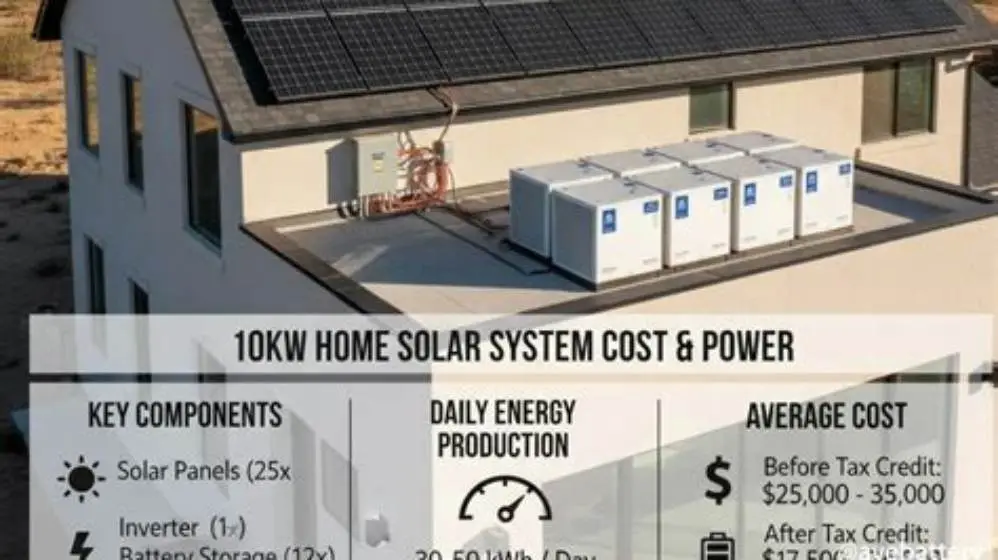
A 4 kW solar system with a diverter typically saves £150–£400 yearly. Savings depend on excess solar generation, your electricity tariff and immersion heater size. Payback ranges from 6–12 years before grants; shorter if you've already installed panels.
On this page
- Quick recap
- How solar diverters use excess solar PV to heat water
- Expected electricity savings in kWh and pounds per year
- How electricity tariff and system setup influence savings
- Installation cost and payback timescale
- Comparison to not using a solar diverter
- When a solar diverter makes financial sense
- Quick questions
Part of our guide on comparing internal and external costs
Quick facts
- Typical annual saving
- £150–£400
- System size assumed
- 4 kW PV array
- Excess solar needed
- 2–4 kWh per day
- Installation cost
- £800–£1,500 fitted
- Payback period
- 6–12 years
- Electricity rate affects savings by
- ±50% either side
Quick recap
- Savings scale with spare solar output: a system that overproduces by 2–4 kWh daily saves more than one that rarely exceeds demand.
- Export tariffs now compete with diverter savings. At 15p/kWh export rate, diverting is marginal unless your immersion heater is undersized or tariff drops.
- Installation cost (£800–£1,500 fitted) and your electricity rate determine payback. Under 20p/kWh unit rate, payback typically takes 8–12 years.
- A diverter works best on time-of-use or half-hourly tariffs where you export at low rates. Standard Economy 7 offers little benefit unless you heat mostly in summer.
- Immersion heater capacity matters: a 3 kW heater draws more diverted solar than a 2 kW model, but requires thicker wiring and a suitable CU board slot.
How solar diverters use excess solar PV to heat water
A solar diverter monitors your home's import and export in real time. When your PV panels produce more power than you're using, the diverter diverts that spare electricity to your immersion heater instead of exporting it to the grid. The heater warms your hot-water tank at zero cost to you.
The control unit sits between your meter and your consumer unit. It reads the grid current and switches the immersion heater element on and off in millisecond bursts, matching the heat to your spare solar output. Some models work with smart meters and use half-hourly export data; others use a clamp sensor on the main live wire.
Diverters work only when your solar generation exceeds your home's demand. On a sunny day, your kettle and lights use 1–2 kW but your panels make 3–4 kW. That spare 1–2 kW goes to the heater. On a cloudy day or at dusk, the diverter stays off and you heat water as normal, pulling from the grid or export tariff income.
The heater element must be a dedicated immersion heater, not a boiler's main heater. Most gas or oil boilers can't use a diverter because their heat exchangers aren't designed for intermittent, variable heating. A storage cylinder with a separate immersion element (or a heat pump with an immersion backup) works well. We go through are smart thermostats easy to install step by step elsewhere on the site.
Expected electricity savings in kWh and pounds per year
Savings depend entirely on how much spare solar you generate and can't use at the moment it's made. A 4 kW array on a south-facing roof in the Midlands produces roughly 3,200 kWh annually. If your household demand is 2,500 kWh, you have around 700 kWh left to export or divert. In practice, overlap is messier: you'll export more on summer weekends and have less spare on winter mornings.
A realistic estimate for a 4 kW array in a household that uses 2,000–2,500 kWh yearly is 200–400 kWh diverted annually. That's 15–30 kWh per month on average, or roughly the energy in 15–30 kettle-boils per day across the year. Some months (May to August) you'll divert 50–80 kWh; in winter, nearly zero.
At current electricity rates, 200–400 kWh diverted saves £30–£80 per year if your unit rate is 15–20p/kWh. If you're on a 12p unit rate (some cheap off-peak hours), savings fall to £24–£48. At 25p/kWh, the same energy's worth £50–£100. The difference between tariffs is not trivial: a 10p swing changes annual savings by £20–£40. Before you commit to anything, it is worth looking at comparing cost per kWh.
Compare that to export income you'd lose. If you export the same 200–400 kWh at 15p/kWh (a typical current export rate), you forgo £30–£60 annually. If your export rate is 5–8p/kWh, the choice is starker: divert and save heat; export and earn less than £10–£32. The financial case often hinges on whether your import rate is significantly higher than your export rate.
| Diverted energy per year | At 12p/kWh import rate | At 15p/kWh import rate | At 20p/kWh import rate | At 25p/kWh import rate |
|---|---|---|---|---|
| 200 kWh | £24 | £30 | £40 | £50 |
| 300 kWh | £36 | £45 | £60 | £75 |
| 400 kWh | £48 | £60 | £80 | £100 |

Split Core Current Transformer Sensor Split Core Current Transformer
Clamps around your main live wire to read grid flow up to 100 A, so your diverter knows exactly when spare solar is available to push into the immersion heater.
How electricity tariff and system setup influence savings
Your savings shrink or grow with three variables: how much solar your panels make, how much you use at the moment it's made, and what you're charged for it. A system that generates 5,000 kWh yearly but uses only 1,500 kWh on-site has 3,500 kWh to either export or divert. A system making 3,200 kWh in a 3,500 kWh household wastes almost nothing because demand and supply align.
Time-of-use tariffs reward diverters. If your unit rate is 20p during peak hours (5–9 pm weekdays) but only 8p off-peak, a diverter that heats your water at 2 pm on solar alone dodges peak charges. You save 20p per kWh instead of earning 15p on export. Switching from a flat 18p tariff to a time-of-use rate can double the diverter's value. We go through cost per UPVC door sealing step by step elsewhere on the site.
Economy 7 and similar off-peak schemes often don't suit diverters. You already heat water cheaply at night (around 7–9p/kWh). Diverting 2 kWh at 2 pm saves you heating that water later at 7p but costs you export income at 15p. The maths say export, not divert. Diverters only help on Economy 7 if your immersion heater is small or your tariff dropped sharply.
Half-hourly metering lets you track the real value of diversion. Smart meters record every 30 minutes whether you're importing, exporting or balanced. Some diverter apps show you live export rate and can pause diversion if the rate rises. Without half-hourly data, you assume an average export rate, which may mask good diversion windows.
Immersion heater capacity changes the game. A 3 kW heater pulls more solar than a 2 kW model and fills your tank faster. If your tank is small (80 litres) and heater undersized (2 kW), you can only divert when solar is very high and demand very low. A 3 kW heater in the same tank reaches temperature sooner and uses more of your spare output, raising annual savings by 20–40 kWh. We go through insulated plasterboard price step by step elsewhere on the site.
- Check your electricity bill or supplier app for your unit rate and tariff name.
- Note whether you're billed at a flat rate all day or time-of-use (peak, off-peak, shoulder).
- Find your export rate from your generation meter or supplier statement (usually 10–20p/kWh).
- If unit rate is below 15p or above export rate by less than 3p, payback is marginal.
- If unit rate is 18p or higher and export is 12p or lower, a diverter becomes attractive.
Installation cost and payback timescale
A solar diverter unit itself costs £200–£500 depending on model and control sophistication. Most UK installers charge £800–£1,500 fitted, including the control relay, wiring upgrades if needed, immersion element isolation switch, and testing. Some charge by the day at £600–£800; others quote flat rates. If you're retrofitting a consumer unit with limited space or upgrading the immersion circuit from 10A to 20A wire, costs can reach £1,500–£2,000.
Payback assumes steady-state use over many years. At £150 annual savings, payback is 10 years without grant help. At £300 annual savings, payback is 4–5 years. The difference between a good and poor installation scenario is 5–7 years of payback time, which matters when equipment lasts 15–20 years.
The Boiler Upgrade Scheme doesn't fund diverters, and ECO4 rarely does. You may claim diverter costs against an Enhanced Capital Allowance if your property is a rental, but residential homes get no direct grant. Some installers bundle diverters with solar packages at a discount, reducing your true cost to £600–£1,000. If that sounds like your situation, read up on gas combi boiler lifespan and annual service cost uk next.
Payback improves if you already have solar panels or a heat pump with immersion backup. Adding a diverter to existing panels costs only the fitted installation (£800–£1,500) with no panel cost. If you're buying solar and a diverter together, negotiate a package price; the marginal cost of adding a diverter to a solar quote can be as low as £400–£600.
Rising electricity rates accelerate payback. If unit rates climb from 15p to 20p, annual savings jump by £30–£60 depending on diverted energy. That cuts payback by 1–2 years. Falling export rates have the opposite effect and are common, so don't assume payback improves over time without rechecking rates annually.
| Annual saving | At £800 install cost | At £1,000 install cost | At £1,500 install cost |
|---|---|---|---|
| £150/year | 5.3 years | 6.7 years | 10 years |
| £250/year | 3.2 years | 4 years | 6 years |
| £350/year | 2.3 years | 2.9 years | 4.3 years |
Comparison to not using a solar diverter
Without a diverter, spare solar goes to the grid. You're paid the export tariff (typically 10–20p/kWh). With a diverter, you avoid buying that energy later. The comparison depends on whether you'd import that energy at peak hours or off-peak.
In summer, you generate most and use least. Without a diverter, you export 50–70% of your solar output at 15p/kWh, earning £80–£150 from May to August. With a diverter, you divert perhaps 30–40% of that spare (the portion you can heat into) and export the rest. You earn less export income but save on immersion heating. Net gain is small: perhaps £5–£20 over four months.
In winter, you generate little and use more. The diverter sits idle most of the time because spare solar is rare. You heat water as normal, buying grid energy. The diverter saves nothing in December and January. It only pays in shoulder months (April, May, September, October) when both solar and demand are moderate.
The real win is on shoulder days with mild weather and high solar: April mornings, September afternoons. Your panels make 3–4 kWh/hour and you need only 1 kWh for lights and standby. The 2–3 kWh spare either exports at 15p (£0.30–£0.45 per hour) or diverts to heat (saving 15–20p per kWh in future grid energy). The financial difference is small. The diverter's true advantage is resilience: you heat water from your own generation rather than betting on export rates staying high.
Without a diverter, you're exposed to export rate collapse. If your tariff drops from 20p to 5p, your solar income halves overnight. A diverter hedges this risk: it converts spare generation into stored thermal energy (hot water) that you use regardless of tariff. This non-financial benefit (fuel independence) can justify the cost even when payback is 8–10 years.
- Export income: earn 10–20p per kWh exported. Diverter saves that rate by heating instead.
- Peak pricing: if you heat water during peak hours (5–9 pm), export avoids peak charges. Divert during off-peak solar (2–4 pm) to save peak rates later.
- Tariff risk: falling export rates penalise grids users; diverters lock in thermal storage and reduce that exposure.
- Maintenance: diverters have no moving parts and need no servicing. No comparison to other heating methods.
- Reduces grid reliance and export volatility
- Guarantees you use some solar for heating
- No moving parts or maintenance needed
- Payback 6–12 years on typical rates
- Saves little in winter when solar is sparse
- Requires immersion heater, not all boilers suit
When a solar diverter makes financial sense
A diverter pencils out if three conditions align: you have spare solar regularly, your unit rate is 15p or higher, and your export rate is 12p or lower. If you tick all three, payback is usually 5–8 years. Tick two, and payback extends to 8–12 years. Tick one or zero, and it's a speculative purchase.
You have spare solar if your panels' peak output (summed in kW) is 25–50% higher than your home's typical demand. A 4 kW array on a household using 3–4 kWh/day on average meets this. A 3 kW array on a household using 5–6 kWh/day does not: you use almost everything on-site and have little to divert.
Your unit rate matters most. At 25p/kWh and 10p export, diversion saves 15p per kWh diverted. At 15p unit rate and 12p export, it saves only 3p per kWh. Scale that across 300 kWh annually: £45 versus £9. The first case pays for itself in under 20 years; the second takes 100.
Diverters also suit homes planning heat pump installation. A heat pump with an immersion heater backup can be pre-plumbed for a diverter at build time, lowering retrofit cost. The diverter then tops up the cylinder on sunny days, reducing grid heating and improving heat pump efficiency.
If your export rate is volatile or trending downward, a diverter becomes more attractive each year. Locking spare generation into thermal storage protects you from future rate cuts. This is a valid reason even if the financial case is weak today.
- Calculate your typical surplus solar: (panel kW × peak sun hours in your region) minus average daily demand in kWh.
- Check whether that surplus occurs on days you're home and can use hot water (weekends, work-from-home days).
- Find your unit rate and export rate on your latest bill or online account.
- If unit rate minus export rate is 5p or more, and surplus is 2+ kWh per day on average, a diverter likely pays.
- If unit rate is below 15p or export is above 15p, reconsider unless you have other motives (resilience, future-proofing).
Quick questions
Do I need a heat pump to use a solar diverter?
No. Any home with an immersion heater (whether fed by a boiler, heat pump, or standalone cylinder) can use a diverter. Gas and oil boilers with separate immersion elements work fine. Heat pumps with immersion backup are also suitable. The only requirement is a dedicated immersion element and a consumer unit with a free breaker slot.
What if my export rate is higher than my unit rate?
Export and don't divert. If you're paid 20p/kWh and charged 18p/kWh, sending power to the grid earns more than heating your water saves. This often happens on premium export tariffs or when supply is tight. Check rates quarterly: if rates flip, the diverter's value changes instantly.
Can a diverter overheat my water tank?
No. The diverter switches the immersion element on and off in pulses proportional to your spare solar. If solar exceeds demand by 500 W, the heater pulses at 50% duty cycle. It won't raise temperature above your thermostat setting because the element cycles off once the cylinder reaches target.
How long does it take to heat a tank with diverted solar?
Depends on element size and solar output. A 3 kW element with 2 kWh spare solar takes roughly 1 hour to add 10–15°C to an 80-litre cylinder. A 2 kW element takes 90 minutes. On cloudy days or early morning, heating may take 3–4 hours because spare solar is lower. Full tank heating happens on clear summer days between 11 am and 3 pm.
Will a diverter work on Economy 7 or other off-peak tariffs?
Marginally. You already heat water cheaply at night. A diverter that heats in the afternoon avoids that cheap off-peak rate but loses export income. Unless your immersion heater is very undersized or you heat mostly in peak hours, payback is poor on Economy 7. It suits flat-rate or time-of-use tariffs where peak and off-peak rates diverge widely.
What maintenance does a diverter need?
None. Diverters have no moving parts: just solid-state relays and circuit boards. They last 15–20 years like any electrical component. Have your immersion element descaled every 3–5 years if water is hard (a maintenance task for the heater, not the diverter).