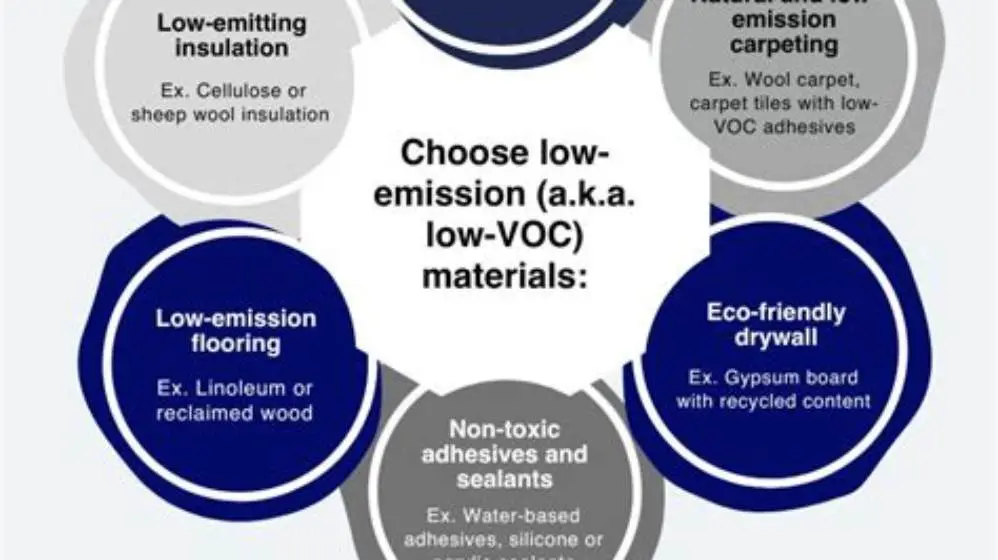
Low VOC materials emit less than 0.29% by mass for indoor paints under EN 13300 and decorative coatings. Products carrying EU Ecolabel, Blue Angel or Indoor Air Comfort Gold meet formal emission thresholds measured in test chambers over three or 28 days.
On this page
- Quick recap
- What low VOC means in formal terms
- The VOC emission thresholds that define low VOC
- What makes a product formally qualify as low VOC
- Common low VOC products and where to find certification
- The difference between low and high VOC products
- How to check a product meets the formal threshold
- Quick questions
Part of our guide on voc emission standards for flooring
Quick facts
- Low VOC paint limit
- under 0.29% by mass (EN 13300)
- EU Ecolabel ceiling
- 30 g/l for matt emulsion
- Blue Angel threshold
- 1 g/l for indoor paints
- Chamber test duration
- 3 days and 28 days
- High VOC boundary
- above 0.5 kg per m³
- Indoor Air Comfort
- Gold: below 0.1 mg per m³·h
Quick recap
- Indoor paints qualify as low VOC below 0.29% by mass under EN 13300, the European standard for water-based coatings
- Look for EU Ecolabel, Blue Angel or Indoor Air Comfort Gold labels: each sets emission ceilings measured in test chambers
- VOC limits differ by product type: adhesives, sealants and flooring each have separate thresholds under the Construction Products Regulation
- High VOC materials emit above 0.5 kg per m³ in chamber tests: low VOC products stay well below 0.1 kg per m³
- Always check the technical datasheet for the actual emission figure in
g/lor percentage, not just a 'low VOC' claim on the tin
What low VOC means in formal terms
Low VOC describes materials with volatile organic compound emissions below a defined threshold, measured either as mass percentage in the wet product or as airborne concentration after application. It is a regulatory and certification term, not a descriptor manufacturers can use freely. A product qualifies when it passes chamber emission testing to a recognised standard and carries proof on the label.
The European standard EN 13300 sets the benchmark for decorative paints. Water-based coatings must emit less than 0.29% VOC by mass to meet the low-emission class. Solvent-based paints have a higher ceiling at 8% by mass, reflecting their chemical base. The difference matters for indoor air quality: a water-based emulsion at 0.2% releases a tenth of the VOCs of a solvent product at 5%.
VOC content is not the same as emission rate. A paint might contain 30 grams per litre of VOCs in the tin, but the figure that affects indoor air is how much evaporates per square metre per hour after you apply it. Test chambers measure this over three days and 28 days under controlled temperature and air exchange, giving a realistic picture of what happens in a room. The 28-day figure captures slower off-gassing from deep in the film.
In the UK, the Construction Products Regulation requires manufacturers to declare VOC emissions for products used in buildings. That obligation pushes certification schemes such as EU Ecolabel, Blue Angel and Indoor Air Comfort into common use. Each scheme sets its own ceiling, always stricter than the legal minimum, and tests to ISO 16000 or equivalent chamber methods. You can trust the label because the testing is third-party and the thresholds are published. We go through preventing blistering on bathroom plaster step by step elsewhere on the site.
The VOC emission thresholds that define low VOC
Low VOC thresholds vary by product category and certification body, but all rest on the same principle: airborne concentration must stay below a ceiling measured in a test chamber. The EU Ecolabel for indoor paints sets 30 grams per litre for matt emulsion and 100 g/l for trim paint. Germany's Blue Angel is stricter at 1 g/l for most interior coatings. Indoor Air Comfort Gold, used across Europe, demands emissions below 0.1 milligrams per cubic metre per hour after 28 days.
For flooring, the limit is typically 0.05 mg per m³·h at day 28 under AgBB or Indoor Air Comfort. Adhesives and sealants have separate ceilings: 0.3 mg per m³·h for flooring adhesive, 0.5 mg per m³·h for sealants. These figures come from chamber tests at 23°C, 50% humidity and an air change rate of 0.5 to 1 per hour, conditions that mirror a ventilated room. A product emitting 0.04 at day 28 qualifies; one at 0.12 does not.
The difference between a low and very-low VOC material is often a factor of ten. A standard low-emission paint might emit 0.08 mg per m³·h; an ultra-low product hits 0.01 mg per m³·h. That gap matters in spaces with poor ventilation or where occupants are sensitive to fumes. The stricter German and Scandinavian standards recognise this and set lower bars than the EU baseline. People in this spot often ask about low voc paint definition as well.
UK retailers and specifiers increasingly adopt BREEAM and SKA rating credits, which accept products certified to Indoor Air Comfort or equivalent. The practical threshold you should look for is below 0.1 mg per m³·h at day 28 for any coating, adhesive or finish applied indoors. Anything higher than 0.3 mg per m³·h is not low VOC under current best practice, even if it meets older regulations.
| Scheme | Product | Threshold | Test duration |
|---|---|---|---|
| EU Ecolabel | Matt emulsion | 30 g/l | — |
| Blue Angel | Indoor paint | 1 g/l | — |
| Indoor Air Comfort Gold | All coatings | 0.1 mg/m³·h | 28 days |
| AgBB | Flooring | 0.05 mg/m³·h | 28 days |
| Indoor Air Comfort | Adhesive | 0.3 mg/m³·h | 28 days |
| Indoor Air Comfort | Sealant | 0.5 mg/m³·h | 28 days |
What makes a product formally qualify as low VOC
A product qualifies when it passes third-party emission testing to a recognised standard and the result falls below the scheme's ceiling. Testing involves placing a sample in a sealed chamber at controlled temperature and humidity, then measuring airborne VOC concentration over three days and 28 days. The lab reports total VOC and individual compounds, usually to ISO 16000-6 or -9. If the day-28 figure is under the threshold, the product earns certification.
Manufacturers reformulate to cut emissions by replacing high-VOC solvents with water, low-volatility coalescents or bio-based alternatives. A traditional gloss paint used white spirit as the carrier, releasing 400 to 600 g/l of VOCs. A modern water-based gloss uses acrylic resin and glycol ethers, emitting 15 to 30 g/l. The shift is chemical: fewer aromatic hydrocarbons, more long-chain alcohols that evaporate slowly or not at all. Before you commit to anything, it is worth looking at low voc levels in ceramic tiles.
Certification is annual or biennial. The testing body audits production batches to ensure consistency, so a label from 2024 means the product met the threshold that year. Some schemes require worst-case testing: the colour with the highest pigment load or the formulation with the most additives. That guarantees every variant in the range qualifies, not just the base white.
Not all low-VOC products carry a label. Trade coatings and adhesives often publish emission data on technical sheets without seeking formal certification, especially when sold business-to-business. The datasheet will state 'tested to ISO 16000-9' and give the result in mg per m³·h. That is enough for a specifier to judge compliance with BREEAM or building regulations, but a consumer should prefer a certified product because the testing was independent and the threshold is clear.
Common low VOC products and where to find certification
Water-based emulsion paints are the most common low-VOC materials in UK homes. Brands such as Dulux Trade Diamond, Farrow & Ball Modern Emulsion and Little Greene Intelligent Matt all carry EU Ecolabel or publish emission data below 0.1 mg per m³·h. Trim paints and eggshell finishes have crept below 30 g/l in water-based formulations, though solvent versions still hit 300 g/l and do not qualify. People in this spot often ask about natural insulation low carbon as well.
Flooring adhesives certified to Indoor Air Comfort include Bostik Universal and Mapei Ultrabond Eco. Both emit under 0.05 mg per m³·h at day 28 and suit engineered wood, vinyl and carpet tiles. For sealants, Soudal Fix All and Geocel The Works stay below 0.1 mg per m³·h and carry low-emission marks. These products cost 10 to 20% more than uncertified equivalents but off-gas faster, letting you occupy the room sooner.
Engineered wood flooring with Eurofins Indoor Air Comfort Gold certification includes brands such as Kährs and Boen. Both use low-formaldehyde adhesives in the core and finish coats below 0.05 mg per m³·h. Vinyl plank flooring with FloorScore or Indoor Air Comfort meets the same threshold. Sheet vinyl without certification can emit 0.3 to 0.8 mg per m³·h for weeks, so the label matters.
MDF and plywood sold as low-VOC usually means low formaldehyde rather than low total VOC. Look for CARB2 or E0.5 ratings, which cap formaldehyde at 0.05 parts per million. OSB and particleboard rarely qualify as low VOC unless stated on the datasheet. For insulation, mineral wool and rigid foam boards emit negligible VOCs, but spray foam can off-gas for three to six months unless the product is certified low-emission. People in this spot often ask about environmental impact of wool as well.
- Paint: EU Ecolabel, Blue Angel or Indoor Air Comfort - check the tin or the product page for the logo
- Adhesive: Indoor Air Comfort or Emicode EC1 Plus, both capped at 0.05 mg/m³·h
- Flooring: Eurofins Indoor Air Comfort Gold or FloorScore, tested to ISO 16000
- Sealant: low-modulus MS polymer or hybrid formulations with declared emissions under 0.1 mg/m³·h
- Sheet materials: CARB2 or E0.5 for formaldehyde, but always ask for total VOC data if indoor air quality is critical
The difference between low and high VOC products
High VOC products emit above 0.5 kg per m³ in chamber tests, typically because they rely on white spirit, xylene or acetone as carriers. Traditional gloss, varnish and spray primers fall into this bracket, releasing fumes for seven to fourteen days. Low VOC alternatives stay below 0.1 kg per m³, often hitting 0.02 to 0.05 kg per m³, and reach stable emissions within three days. The practical difference is ventilation time: a high-VOC room needs windows open and extract fans running for a week; a low-VOC room is habitable after a weekend.
Odour intensity tracks VOC level but is not the same. Some low-VOC products smell stronger than high-VOC ones because they use ammonia or amine catalysts that have a sharp odour at low concentration. Conversely, a solvent paint can smell mild if it uses odourless mineral spirits, yet still emit 500 g/l. The test chamber result is the reliable measure, not your nose.
Health risk scales with both concentration and compound type. Aromatic hydrocarbons such as toluene and benzene, common in high-VOC coatings, are respiratory irritants and long-term carcinogens. Low-VOC products replace these with aliphatic alcohols and glycol ethers, which are less toxic and evaporate more slowly. A material emitting 0.3 mg per m³·h of toluene is riskier than one emitting 0.8 mg per m³·h of propylene glycol, even though the total VOC is lower in the first case.
Performance differences have narrowed. Water-based gloss now matches solvent gloss for hardness and sheen, and low-VOC flooring adhesive bonds as strongly as solvent types. The trade-off is drying time: low-VOC products can take two hours between coats instead of one, and some need 24 hours to cure rather than twelve. In cold or damp conditions below 10°C or above 80% humidity, water-based coatings struggle, whereas solvent products tolerate tougher environments.
| Attribute | High VOC | Low VOC |
|---|---|---|
| Chamber emission | Above 0.5 kg/m³ | Below 0.1 kg/m³ |
| Typical content | 300–600 g/l | 10–50 g/l |
| Ventilation needed | 7–14 days | 2–3 days |
| Main solvents | White spirit, xylene | Water, glycol ethers |
| Odour duration | One to two weeks | One to two days |
| Drying time | 1–2 hours per coat | 2–4 hours per coat |
How to check a product meets the formal threshold
Start with the label. Look for EU Ecolabel, Blue Angel, Indoor Air Comfort or Emicode EC1 marks printed or embossed on the tin or packaging. Each logo means the product passed third-party testing to a published threshold. If the label is absent, check the technical datasheet on the manufacturer's website. Search for 'VOC content' in g/l or 'emission rate' in mg per m³·h. A figure below 30 g/l or 0.1 mg per m³·h at day 28 confirms low VOC.
When the datasheet lists only VOC content, not emission rate, the product has not been chamber-tested. Content tells you what is in the tin; emission tells you what reaches the air. A paint with 25 g/l content could still emit 0.2 mg per m³·h if the solvents evaporate quickly. Ask the supplier for ISO 16000-9 test results before specifying the product for a project with air-quality requirements.
For flooring and adhesives, check the product page for FloorScore, Indoor Air Comfort Gold or GUT certification. These schemes test to the same chamber method and publish pass lists online. If a product claims low VOC but carries no mark, email the technical support team and request the emission test report. A legitimate low-VOC manufacturer will send it within a day; evasion suggests the claim is not backed by data.
Third-party verification matters because self-certification is unregulated. A brand can print 'low VOC' on a tin without testing, and trading standards rarely challenge it unless a complaint is filed. Independent marks such as Blue Angel and Indoor Air Comfort involve annual audits, batch testing and public disclosure of thresholds. That transparency is the difference between a marketing claim and a formal qualification.
- Label check: EU Ecolabel, Blue Angel, Indoor Air Comfort or Emicode - present on the packaging or product page
- Datasheet: VOC content under 30 g/l or emission rate below 0.1 mg/m³·h at 28 days, tested to ISO 16000
- Certification database: search the Indoor Air Comfort or Blue Angel online registers by product name
- Direct enquiry: ask the manufacturer for the test report if the datasheet is vague or missing
Quick questions
Can a product be low VOC but still smell strong?
Yes. Odour comes from specific compounds such as ammonia or short-chain amines, which can smell sharp even at low concentration. A product might emit only 0.05 mg per m³·h total VOC yet smell stronger than a solvent paint emitting ten times that. The test chamber result is what matters for indoor air quality, not the smell. Ventilate the room for two days regardless of odour intensity.
Do all EU Ecolabel paints meet the same VOC threshold?
No. The EU Ecolabel sets different ceilings by product type: 30 g/l for matt emulsion, 100 g/l for trim paint, and higher again for primers. All are lower than the regulatory baseline, but not all are equally low. For the strictest limit, look for Blue Angel at 1 g/l or Indoor Air Comfort Gold at 0.1 mg per m³·h after 28 days.
Is low VOC the same as zero VOC?
No. Low VOC means emissions below a defined ceiling, usually 0.1 mg per m³·h. Zero VOC implies no detectable emissions in a test chamber, typically below 0.005 mg per m³·h, a threshold only a handful of products meet. Most zero-VOC paints still contain trace solvents but off-gas so slowly the chamber result rounds to zero. Check the datasheet for the actual figure.
How long does a low VOC material continue to emit after application?
Most low-VOC coatings reach stable emission within three to five days, with the bulk of off-gassing in the first 24 hours. Chamber tests measure at three days and 28 days; by day 28, emissions are typically one-tenth of the day-three figure. High-VOC products can off-gas for two to four weeks. Ventilate continuously for the first three days, then intermittently for a week.
Do low VOC products cost significantly more?
They cost 10 to 20% more than standard equivalents: typically £2 to £5 extra per litre of paint or per square metre of flooring. The premium reflects reformulation and certification costs. The saving is in ventilation time and avoided health risk, especially in homes with children, elderly occupants or anyone with respiratory conditions.
Can I use a VOC meter to verify the product claim?
A consumer VOC meter gives a rough indication of airborne concentration in mg per m³, but it cannot verify compliance with a formal threshold because it measures total VOC, not the specific emission rate per square metre per hour. For verification, you need the manufacturer's ISO 16000 test report. A meter is useful for checking ventilation progress and confirming the room is below 0.3 mg per m³ before reoccupation.