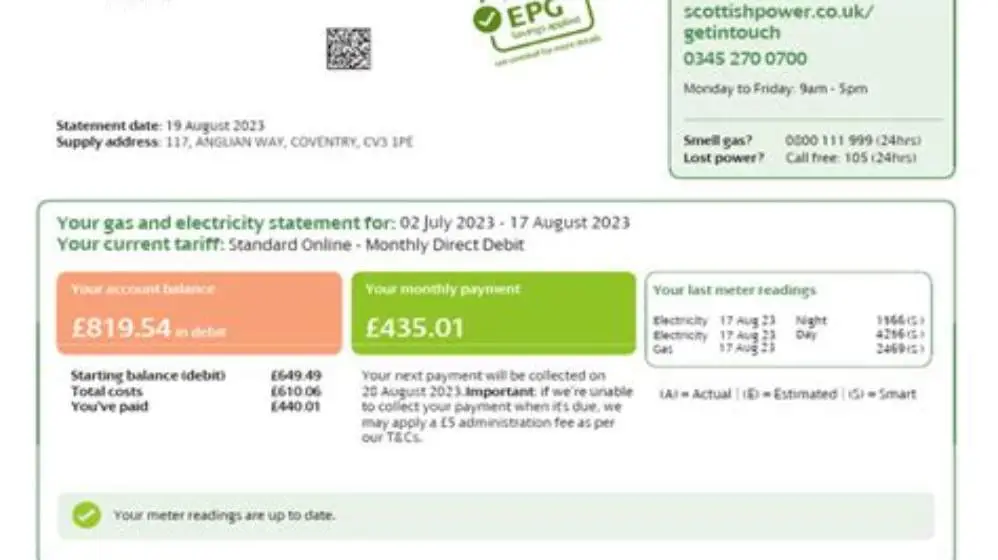
Scottish Power's standard tariff is usually a standard variable tariff with no fixed term. Its unit rates and standing charges change when Ofgem changes the price cap. Your exact price depends on region, payment method and the product name shown on your bill. Check Scottish Power's current price book and Ofgem's latest cap tables before comparing costs.
On this page
Part of our guide on how to monitor home energy usage
Quick facts
- Tariff type
- Usually standard variable
- Contract length
- No fixed end date
- Exit fees
- Usually none on the standard variable tariff
- Rate changes
- When the applicable Ofgem cap changes
- Regional pricing
- Rates depend on postcode and distribution area
- Payment methods
- Direct debit, prepayment and standard credit may differ
- Best source
- Scottish Power price book and Ofgem cap tables
Quick recap
- The standard tariff has no fixed end date and usually has no exit fee.
- Rates vary by region, meter type and payment method.
- Ofgem's price cap sets the maximum allowed rates for most default tariffs.
- Scottish Power markets standard variable tariffs under specific product names, which can change.
- Direct debit, prepayment and standard credit rates can differ. Check your quote and bill.
- Use your postcode and annual kWh usage to calculate your actual cost.
Check what Scottish Power calls your tariff
Scottish Power's standard tariff is a variable default deal. It normally has no fixed end date, so you can leave without waiting for a contract to finish.
The supplier may market this tariff under a specific product name. Names and availability change as Scottish Power updates its offers. Scottish Power is part of the Iberdrola group, but its prices still depend on the UK market rules applying to your account.
Read the tariff name on your bill, welcome email or online account. Then match it with the current Scottish Power price book before comparing rates.
Scottish Power publishes price information by region and payment method. Ofgem publishes the cap tables separately. Use both sources, because the cap is not a single UK-wide unit rate. If that sounds like your situation, read up on logging interval too coarse emonpi next.
Check your current unit rates and standing charges
No single Scottish Power standard tariff price applies everywhere. Rates vary across electricity distribution areas, gas regions and payment methods.
For a current figure, use Scottish Power's price book for your postcode and tariff name. Check the publication date. Ofgem's published price cap tables provide a useful cross-check for the same period.
A practical guide is to expect electricity standing charges of roughly 50 to 70p per day, depending on region and payment method. Gas standing charges can also vary by region. Treat those ranges as a starting point, not a quote. People in this spot often ask about how long does energy switch take as well.
Your bill shows the exact unit rate in pence per kWh and the daily standing charge. Multiply the unit rate by your annual kWh usage. Add 365 days of standing charges for a rough yearly cost.
Ofgem's cap figures use a typical household allowance for comparisons. Your bill will differ if your home uses more or less energy. Check your last 12 months of meter readings instead of relying on an example household.
Check how the contract works
A standard variable tariff normally has no minimum term. You keep the tariff until you switch, move supplier or choose another Scottish Power product. There is more on limitations of low cost ammeters in a separate guide.
The rates can change when Ofgem changes the price cap. The cap period and payment method affect the maximum rates that apply. Check the latest Ofgem announcement rather than relying on an old calendar.
Scottish Power should tell you about a planned price change through the notice method linked to your account. Read the notice carefully. It should show the new rates and the date they start.
A fixed deal works differently. It locks the rates for the agreed term, though the standing charge and unit rates depend on the contract. A fixed deal can include an exit fee. People in this spot often ask about uk household energy saving tips as well.

EMPORIA Vue 3 Home Energy Monitor
Tracks your home's live electricity use across 16 circuits so you can measure actual daily kWh before judging any tariff switch.
Check exit fees before switching
The standard variable tariff usually has no exit fee. You can normally switch to another supplier or tariff without paying a cancellation charge.
Fixed tariffs follow different rules. Exit fees are set per tariff and shown on your quote or contract. They are typically up to £100 per fuel, but your document is the final authority.
A market convention gives fixed customers a fee-free switching window near the end of the deal. The window is often 49 days. Check your renewal notice because the dates and terms can differ. Before you commit to anything, it is worth looking at how to submeter washer dryer amp draw without electrician.
Outstanding debt can delay a switch in some cases. Ask Scottish Power or your new supplier how any balance will be handled before submitting the application.
Your new supplier usually manages the switch. Keep meter readings from the changeover date and wait for the final Scottish Power bill.
- Standard variable tariff: usually no exit fee
- Fixed tariff: fee set in the quote or contract
- Fixed-deal switching window: often 49 days, but check your renewal notice
- Debt: may affect a switch or final account
- Meter readings: record them on the switch date
Check why your rates change
Ofgem sets a price cap for many default tariffs. The cap limits the rates suppliers can charge, but it does not create one price for every home.
The cap reflects wholesale energy costs, network charges, operating costs and policy costs. Regional network charges create differences between postcodes.
Scottish Power sets its tariff rates within the rules applying to your account. It does not guarantee one rate across England, Wales and Scotland.
The cap period can change during the year. Check Ofgem's latest cap announcement for the exact dates and figures. Scottish Power's price book shows how those limits apply to its own tariff.
A price cap is not a yearly bill limit. It limits unit rates and standing charges. Your total bill still depends on energy use.
Compare the standard tariff with a fixed deal
A fixed tariff can cost more than the standard variable tariff when you take it out. The extra cost pays for protection against later price rises.
A fixed deal can work well if the cap rises during your contract. It can cost more if the cap falls or stays below your fixed rates.
Treat any example premium as illustrative. Suppliers change their prices, and a Scottish Power quote is valid only for the date and details shown.
Compare the estimated yearly cost, not just the electricity unit rate. Include gas, both standing charges, discounts, payment terms and any exit fee.
Use the same annual kWh figures for every quote. Otherwise, the comparison can make one tariff look cheaper for the wrong reason.
| Check | Why it matters | Where to find it |
|---|---|---|
| Electricity unit rate | Shows the cost of each kWh | Price book or quote |
| Gas unit rate | Shows the cost of each gas kWh | Price book or quote |
| Standing charge | Applies every day | Bill or price book |
| Exit fee | Can affect early switching | Fixed-term contract |
| Estimated annual cost | Combines usage and charges | Supplier quote |
Measure your own saving before switching
Open your last 12 months of bills and record electricity and gas usage in kWh. Use actual readings where possible.
Calculate each tariff separately. Multiply electricity usage by the electricity unit rate, then multiply gas usage by the gas unit rate. Add both standing charges for 365 days.
Include any payment discount, smart-meter condition or exit fee. A tariff with a lower headline rate may not be cheaper for your usage.
Prepayment customers should compare the prepayment price shown for their meter. Direct-debit rates do not automatically apply to every payment method.
Ofgem has aligned some payment-method price limits, but supplier offers and account terms can still differ. Check the current Scottish Power price book for your meter type.
Time-of-use tariffs need a suitable meter and compatible terms. Check the night rate, daytime rate, hours, standing charge and any exit fee before switching.
- Record 12 months of electricity and gas usage
- Use the rate for your postcode and payment method
- Add standing charges for the full year
- Check discounts and exit fees
- Compare the total yearly cost
Quick questions
Can Scottish Power change rates on the standard tariff?
Yes. A standard variable tariff can change when the applicable Ofgem price cap changes. Check the latest Ofgem announcement and Scottish Power notice for the dates and rates applying to your account.
Do prepayment customers pay the same rates as direct-debit customers?
Not always. The applicable cap rules can limit differences, but Scottish Power's published prices still depend on meter type and payment method. Check the current price book for prepayment and direct debit separately.
What happens if I move house?
Your new address can have different regional rates and standing charges. Give Scottish Power opening and closing meter readings, then check the tariff offered for the new postcode.
Can I negotiate a lower standard tariff rate?
The standard tariff usually follows published rates rather than individual negotiation. Scottish Power may offer another product, but compare its full quote with the standard tariff and other suppliers.
How long does switching supplier take?
The new supplier normally manages the process and gives you a switch date. Keep using energy normally, record meter readings on that date and wait for Scottish Power's final bill.