Typical ground probe loop lengths for 3-bedroom semi-detached homes depend on heat demand and soil conditions; sizing affects heat pump efficiency and cost.
For a 3-bedroom semi-detached UK home, ground probe loop lengths usually range from 55 to 90 metres per kilowatt of heat demand. Typical total loop length is around 120 to 160 metres, depending on soil thermal conductivity and heat loss.
On this page
- The short version
- How ground probe loop size relates to home size and heat demand
- Typical ground probe loop length range for a 3-bedroom semi-detached house
- How UK ground conditions impact loop sizing
- Why correct ground probe loop sizing affects heat pump performance
- How to roughly size a heat pump and its ground probe loop for your home
- Why site testing and professional design are essential for ground probe loops
- Questions people still ask
Part of our guide on what is a hybrid heat pump
| Heat output | 10-15 kW typical |
|---|---|
| Loop length per kW | 55-90 m/kW |
| Total loop length | 120-160 m typical |
| Soil impact | ±15-30% length |
| Installation requirement | Professional design |
The short version
- Ground probe length scales with heat demand, roughly 55-90m/kW.
- A 3-bedroom semi typically needs 10-15kW heat output.
- Soil type can increase or reduce loop length by 15-30%.
- Proper sizing avoids heat pump inefficiency and cost overruns.
- A qualified installer must design and test for exact loop size.
How ground probe loop size relates to home size and heat demand
Ground probe loop size is primarily determined by the heat demand of your home. For a 3-bedroom semi-detached house in the UK, the typical heat demand ranges between 10 and 15 kW, depending on insulation, airtightness, and local climate.
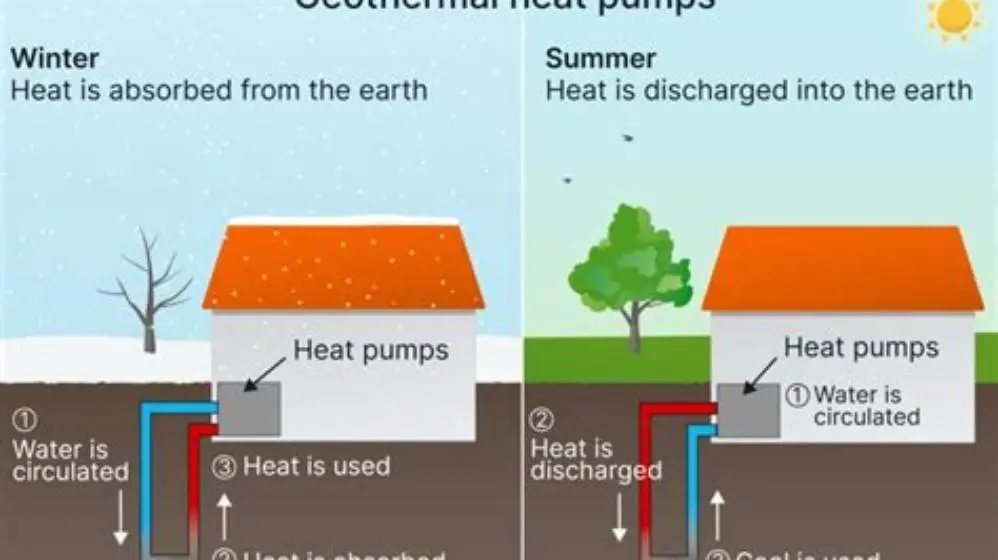
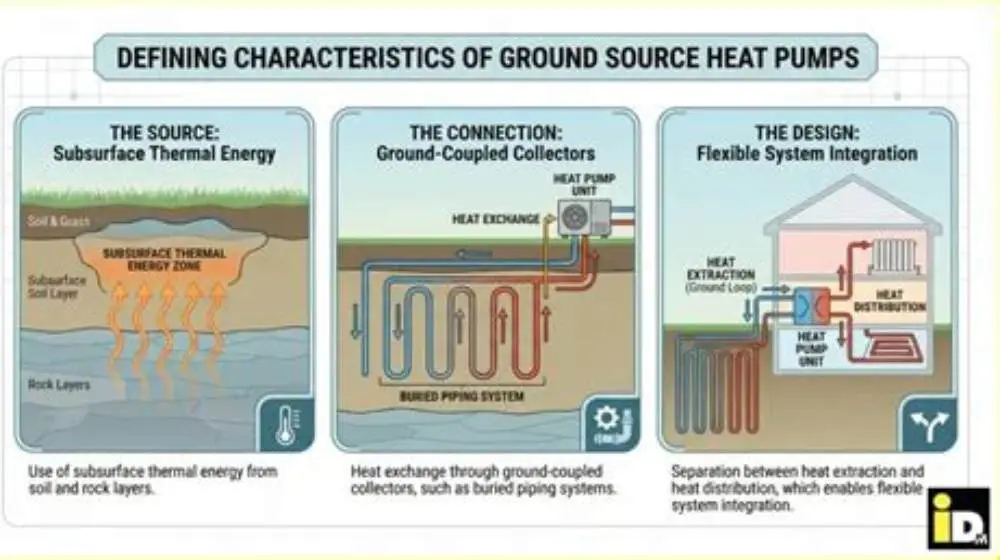
The loop extracts heat from the ground, so the length must be sufficient to provide continuous heat through the heating season without depleting the ground's thermal energy. Hence, the loop length scales with both heat demand and soil thermal properties.
A rough estimation method uses 55 to 90 metres of loop length per kilowatt of required heat output. Lower heat demand homes use the lower end of this range; homes with poorer insulation or colder locations need the upper end.
Typical ground probe loop length range for a 3-bedroom semi-detached house
Applying the 55-90 metres per kW rule, a home needing around 12 kW of heat typically requires a total loop length of about 660 to 1080 metres. However, ground probes are often split into multiple boreholes, each around 50-150 metres deep, rather than one continuous length. The other half of this decision is factors limiting geothermal adoption.
In practice, for a 3-bedroom semi, installers often recommend a total combined probe length between 120 and 160 metres of borehole depth. This shorter length accounts for the multiple probes and the actual installed pipe loop length inside the boreholes.
The variation depends on the home’s exact heat load and the soil's ability to conduct heat away from the probe. This range provides a starting point before specific site tests.
The range of 120 to 160 metres total borehole length generally corresponds to a heat pump size between 4 and 5 kW for typical 3-bedroom semi-detached houses with moderate insulation. However, older homes with less insulation or higher heat loss may need closer to the upper end of this length range or even slightly beyond it to maintain efficiency. People in this spot often ask about maximizing heating efficiency with depth as well.
In some cases, installers may recommend drilling multiple boreholes spaced several metres apart to prevent thermal interference between probes. For example, two boreholes each 80 metres deep might be used instead of a single 160-metre borehole. This arrangement ensures consistent ground temperatures around the probes and prolongs loop life.
A worked example: A 3-bedroom semi needing 12 kW heat output might be sized with a heat pump rated at about 12 kW, implying a total loop length between 660 and 1080 metres by the rule of 55-90 metres per kW. But practical constraints mean installers often opt for multiple boreholes totaling 140 metres depth, balancing space, drilling cost, and ground thermal properties. Post-installation performance monitoring confirms adequacy.
How UK ground conditions impact loop sizing
Soil thermal conductivity varies widely across the UK, from sandy and dry soils with low conductivity to wet clay soils with high conductivity. This affects the ground probe’s ability to absorb heat. The other half of this decision is monitoring pump pressure.
When soil conductivity is poor, loop lengths must increase by 15 to 30% to compensate for slower heat transfer. Conversely, high conductivity soils may allow shorter loops.
Groundwater presence can also improve heat extraction efficiency, potentially reducing loop length requirements. Site-specific soil testing is essential to establish these properties accurately.
Thermal conductivity measurements typically range from about 1.0 to 3.0 W/m·K in UK soils. Sandy soils can be around 1.0 to 1.5 W/m·K, whereas moist clay soils might reach 2.5 to 3.0 W/m·K. This variability means a 20% difference in loop length can significantly affect installation cost and system performance. Before you commit to anything, it is worth looking at do heat pumps provide hot water.
If a site has predominantly sandy soil with poor moisture retention, the loop length might need to be increased by 25 to 30% over standard estimates to avoid excessive ground cooling. Conversely, a site with clay or chalk that retains moisture well might allow a reduction in loop length by up to 15%.
Groundwater flow near the probe can enhance heat extraction by renewing heat in the soil. In such cases, loop length may be reduced by up to 20%, but this depends on consistent groundwater presence. Seasonal variations can change soil moisture, so designs must consider worst-case dry periods.
Why correct ground probe loop sizing affects heat pump performance
An undersized loop will cause the ground temperature around the probe to drop excessively during winter, reducing the heat pump’s coefficient of performance (COP) and increasing running costs. We cover are smaller heat-pumps more efficient in its own article.
An oversized loop increases upfront drilling and material costs unnecessarily without proportional gains in efficiency.
Correct sizing balances installation cost against long-term energy savings. It also helps maintain system reliability and lifespan.
Installers use heat loss calculations, ground thermal properties, and heat pump capacity to size loops precisely. You must insist on this engineering design to avoid poor outcomes.
How to roughly size a heat pump and its ground probe loop for your home
Estimate your home’s heat demand by multiplying floor area by a heat demand factor. For average UK semi-detached homes, this typically ranges between 50 and 70 W/m² depending on insulation levels.
For example, a 90 m² home with moderate insulation might require around 5 to 6 kW heating power. However, 3-bedroom semis often have 10 to 15 kW demand due to size and older construction.
Use the heat demand to estimate loop length with the 55-90 metres per kW rule. This provides a rough figure before site testing.
Always consult a qualified installer who will conduct thermal response tests and ground surveys to tailor the design.
Older construction semi-detached homes built before 1980 often have heat loss factors closer to 70 W/m², pushing heat demand estimates higher. Conversely, newer builds with improved insulation and double glazing may be nearer 40-50 W/m², reducing heat pump size and loop length.
For instance, a 3-bedroom semi with 100 m² floor area and good insulation (50 W/m²) would have a heat demand of 5 kW. Using 70 metres per kW, this implies about 350 metres total loop length. That contrasts with a poorly insulated 100 m² home needing 7 kW and thus 385 to 630 metres loop length, showing how insulation quality influences loop size.
A final check after installation involves monitoring heat pump performance and ground temperature drop during winter. If ground temperature decline exceeds design limits, supplemental heating or loop lengthening may be necessary to maintain comfort and system efficiency.
- Measure or find your home's heated floor area in square metres.
- Estimate heat demand by multiplying area by 50-70 W/m².
- Choose heat pump size equal to or slightly above heat demand.
- Calculate loop length: heat pump kW × 55-90 metres.
- Schedule ground thermal conductivity tests.
- Have installer design final loop layout and length.
Why site testing and professional design are essential for ground probe loops
Ground conditions vary locally, and general rules cannot guarantee correct sizing for your plot. Testing soil thermal conductivity, moisture content, and groundwater influence is critical.
A professional installer will perform thermal response tests by circulating fluid through a test probe in the ground to measure heat transfer rates.
These results guide exact loop length and number of boreholes. The design also considers available land, borehole depth limits, and permissions.
Proper design avoids system underperformance, higher energy costs, and costly retrofits. It ensures eligibility for UK government grants requiring certified installations.
Questions people still ask
Can I install a ground probe loop myself for a heat pump?
No. Installing ground probes requires specialist drilling equipment and knowledge of soil conditions. Improper installation risks system failure and invalidates warranties and grants.
How deep are typical ground probe boreholes?
Boreholes usually range 50 to 150 metres deep in the UK, depending on geology and site access. Total loop length is the sum of all borehole depths.
What if my soil has low thermal conductivity?
Expect to increase loop length by up to 30%. Your installer should identify this via site tests and adjust the design accordingly.
Do ground probe loops require maintenance?
Once installed, ground probe loops are generally maintenance-free. Regular heat pump servicing is still needed to maintain system efficiency.
Are there grants available for ground source heat pumps in the UK?
Yes. Schemes like the Boiler Upgrade Scheme and ECO4 include support for heat pumps, but installations must meet specific design and performance criteria.