The Warm Homes Plan sets no minimum EPC band threshold for eligibility, unlike ECO4 and the Boiler Upgrade Scheme which both impose rating limits.
The Warm Homes Plan does not require a minimum EPC band. Eligibility is based on income thresholds and qualifying benefits, not your property's current energy rating, making it more accessible than ECO4 or the Boiler Upgrade Scheme.
On this page
- The short version
- Does the Warm Homes Plan require a minimum EPC band
- What income and benefit thresholds determine eligibility instead
- How the Warm Homes Plan compares to ECO4 and Boiler Upgrade Scheme EPC thresholds
- How to check your current EPC band for reference
- When you might need an EPC under the Warm Homes Plan despite no threshold
- Why the Warm Homes Plan dropped the EPC band requirement
- Questions people still ask
Part of our guide on raise EPC rating to C
The Warm Homes Plan is the first major UK heating scheme to drop the EPC band requirement entirely, opening support to properties rated A to G.
| EPC band threshold | None — all bands qualify |
|---|---|
| Income limit | £36,000 household income or less |
| EPC required upfront | No |
| ECO4 threshold | D to G only |
| Boiler Upgrade threshold | D to G only |
| Application opens | Early 2025 |
The short version
- Warm Homes Plan has no EPC band threshold: eligibility depends on income and benefits, not your current rating
- You don't need an EPC to apply, though one may be requested after approval to plan the right measures
- ECO4 requires D to G, Boiler Upgrade Scheme needs D to G: Warm Homes Plan accepts any band including A to C
- Check your current EPC band on the government register using your postcode: it's free and instant
- Households with income under £36,000 or receiving qualifying benefits are eligible regardless of property rating
Does the Warm Homes Plan require a minimum EPC band
The Warm Homes Plan sets no minimum EPC band threshold. Eligibility is determined by household income and receipt of qualifying benefits, not by your property's energy performance rating. This marks a significant departure from ECO4 and the Boiler Upgrade Scheme, both of which restrict funding to homes rated D to G.
The scheme targets low-income households earning £36,000 or less per year, or those receiving means-tested benefits such as Universal Credit, Pension Credit, Child Benefit (for larger families), or income-related Employment and Support Allowance. If you meet the income or benefit criteria, your property qualifies regardless of whether it currently holds an A, B, C, D, E, F or G rating.
You do not need an existing EPC certificate to apply. The scheme administrator may request or arrange an assessment after your application is approved, to identify which measures will deliver the greatest energy savings for your home. That assessment informs the installation plan rather than gatekeeping your eligibility.
This inclusive approach reflects the scheme's focus on fuel poverty rather than property performance alone. Many low-income households live in privately rented or older homes with poor ratings, but some occupy newer builds or recently upgraded properties that still struggle with heating costs. The Warm Homes Plan covers both. Before you commit to anything, it is worth looking at house EPC rating thresholds.
What income and benefit thresholds determine eligibility instead
Because the Warm Homes Plan drops the EPC band requirement, it relies on household income and benefit receipt to identify eligible applicants. The two routes are independent: you qualify through either income or benefits, not necessarily both.
The income threshold is set at £36,000 gross household income per year. Household income includes earnings, pensions, rental income and most taxable sources, but excludes disability benefits and Carer's Allowance. You'll need to provide evidence such as recent payslips, P60s, or Self Assessment tax returns. Households earning just over the threshold will not qualify unless they receive a qualifying benefit.
The benefit route accepts a wide range of means-tested support: Universal Credit, Pension Credit (Guarantee or Savings Credit), Child Tax Credit, Working Tax Credit, Income Support, income-related Employment and Support Allowance, income-based Jobseeker's Allowance, Housing Benefit, and Child Benefit where the household has three or more dependent children. If you receive any of these, your income level becomes irrelevant for eligibility purposes. We cover warm homes local grant eligibility england in its own article.
Applications open in early 2025, with installations expected to start in spring. The Department for Energy Security and Net Zero will appoint scheme administrators who handle applications and coordinate approved installers. Funding is allocated per household rather than per property, so tenants in privately rented homes can apply directly if they meet the income or benefit criteria and have landlord consent for the installation.
| Eligibility route | Threshold or requirement | Evidence accepted |
|---|---|---|
| Household income | £36,000 gross per year or less | Payslips, P60, tax return, pension statements |
| Qualifying benefits | Receipt of any listed means-tested benefit | Benefit award letter, Universal Credit statement, Pension Credit notice |
| EPC band | No threshold — all bands accepted | None required upfront |
How the Warm Homes Plan compares to ECO4 and Boiler Upgrade Scheme EPC thresholds
The Warm Homes Plan's absence of an EPC threshold sets it apart from the two other major UK heating schemes running in 2025 and 2026. Both ECO4 and the Boiler Upgrade Scheme impose a D to G band limit, excluding properties rated A, B or C from funding even when occupants face fuel poverty or wish to decarbonise.
ECO4 requires properties to hold an EPC rating of D, E, F or G at the time of application. The scheme targets homes with the poorest thermal performance, prioritising wall, loft and underfloor insulation alongside heating upgrades. If your EPC shows band C or better, ECO4 will not fund any measures, even if you meet the income or benefit criteria. The only exception is a small flexibility allowance for rural off-gas homes, which may cover band C properties in limited circumstances. Before you commit to anything, it is worth looking at landlord rules for EPC C.
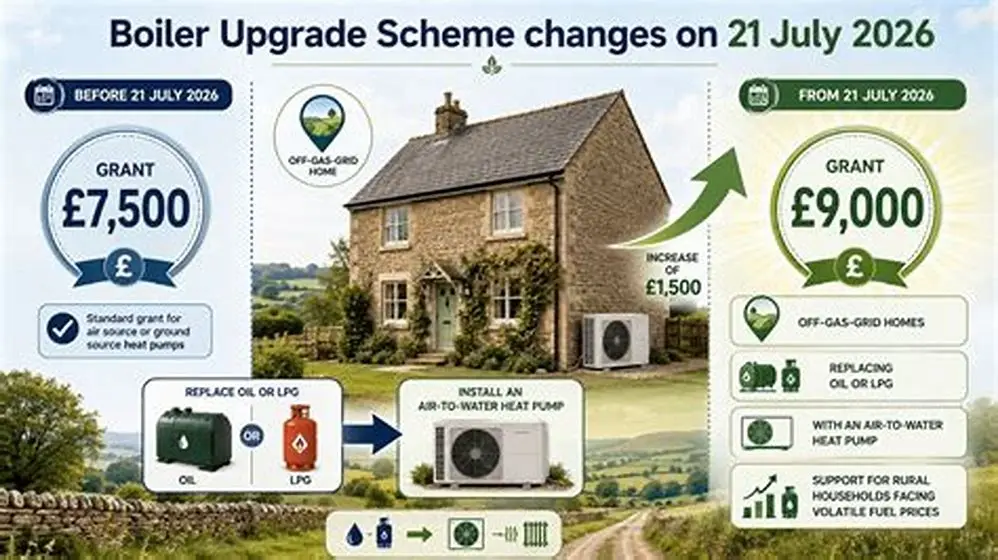
The Boiler Upgrade Scheme also restricts funding to D to G properties when you apply for an air source or ground source heat pump grant. The scheme pays £7,500 toward the heat pump installation cost, but only if your EPC confirms a D or lower rating. Properties with band C can apply if the surveyor identifies cost-effective improvements that would drop the rating to D, but those improvements must be completed and a new EPC issued before the grant is released.
The Warm Homes Plan removes this barrier entirely. A household in a band B flat with storage heaters and high electricity bills can apply. A pensioner in a band C bungalow heated by an old oil boiler can apply. A family in a band G Victorian terrace can apply. All qualify equally if income or benefits line up, and the scheme will fund the measures that deliver the greatest impact for each home.
- ECO4: D to G only, with rare flexibility for rural off-gas band C homes
- Boiler Upgrade Scheme: D to G only, or C if you first improve to D and get a new EPC
- Warm Homes Plan: no band threshold, all ratings from A to G accepted
- Great British Insulation Scheme: D to G only, mirrors ECO4 threshold
How to check your current EPC band for reference
Even though the Warm Homes Plan does not require an EPC band threshold, checking your current rating helps you understand what measures an installer might recommend once your application is approved. Every EPC in England, Wales and Northern Ireland is published on the government's Energy Performance of Buildings Register, and you can retrieve it in under a minute using your postcode. We go through effect on epc replacing oil boiler step by step elsewhere on the site.
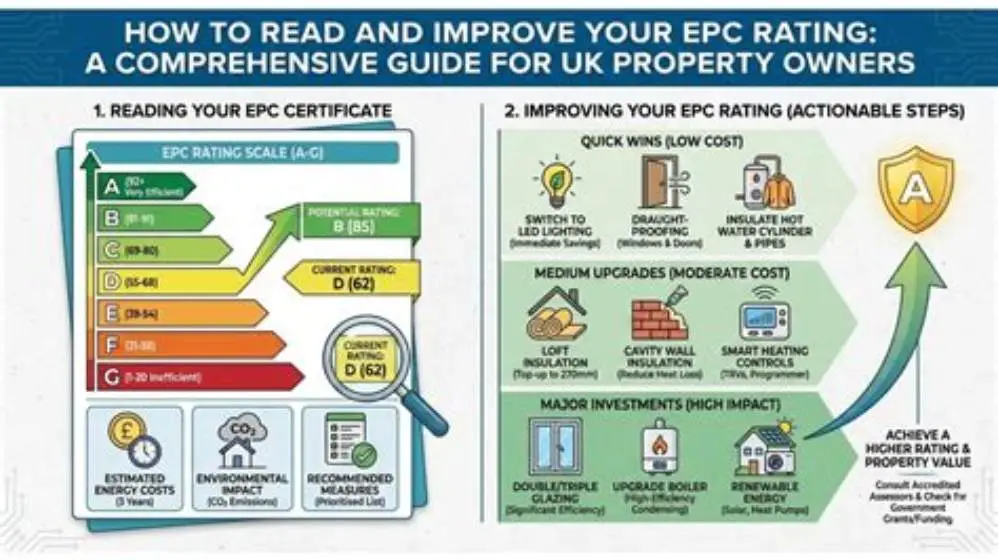
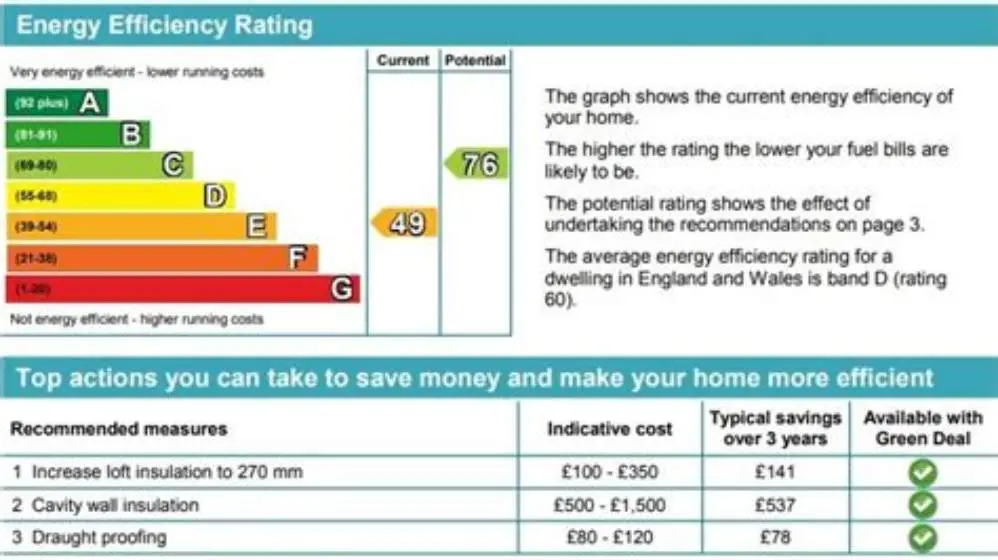
Visit epcregister.com for England and Wales, or epbniregister.com for Northern Ireland. Scotland uses a separate register at scottishepcregister.org.uk. Enter your postcode and select your property from the list. The certificate shows your current band (A to G), a numeric score (1 to 100+), and a breakdown of where heat and energy are lost. Certificates remain valid for ten years unless the property undergoes significant building work.
If no EPC appears, your property may predate 2008, when the requirement was introduced, or the last certificate may have expired. A missing EPC does not disqualify you from the Warm Homes Plan. The scheme administrator or installer will arrange a new assessment as part of the application process, at no cost to you. The assessment identifies your starting performance and determines which combination of measures (heat pump, insulation, glazing, ventilation) will meet your heating needs and maximise savings.
Pay attention to the recommendations section on your existing EPC. It lists measures the assessor identified as cost-effective improvements, often including loft insulation top-up, cavity wall insulation, double glazing, or a heating control upgrade. These recommendations provide a useful preview of what the Warm Homes Plan might fund, though the final package will depend on the installer's survey and the scheme's budget allocation per household. Before you commit to anything, it is worth looking at epc change after adding insulated hot water tank.
- Go to epcregister.com (or the Scottish or Northern Ireland equivalent for your nation).
- Enter your postcode and select your property address from the dropdown list.
- Download the PDF certificate: it opens immediately and shows your current band and score.
- Note the recommendations section at the end for a preview of likely improvement measures.
- If no certificate appears, you do not need to commission one yourself: the scheme will arrange it after approval.
When you might need an EPC under the Warm Homes Plan despite no threshold
The Warm Homes Plan does not require you to hold an EPC certificate before applying, but an assessment will almost always be needed after your application is approved and before any work begins. This assessment serves two purposes: it establishes your property's starting performance, and it guides the choice of measures that will deliver the greatest improvement in comfort and running costs.
The scheme administrator or the appointed installer will arrange this assessment. It is carried out by an accredited Domestic Energy Assessor using the Standard Assessment Procedure (SAP), the same methodology that produces a standard EPC. The assessor records floor area, wall construction, insulation depth, glazing type, heating system age and efficiency, and ventilation provision. The resulting data determines which upgrades are technically and financially justifiable under the scheme's funding envelope.
You will not pay for this assessment. The cost is covered by the scheme or absorbed by the installer as part of the contract. The assessment may generate a formal EPC certificate, or it may produce an internal performance report depending on the administrator's process. Either way, the outcome informs the installation plan rather than acting as a gateway to eligibility. For the detail, see our notes on how to check the epc rating of a property.
If you're a tenant in a privately rented property, the assessment may reveal that your home is currently rated F or G, which would place your landlord in breach of the Minimum Energy Efficiency Standards (MEES). Landlords are prohibited from letting F or G properties unless they have registered a valid exemption or can prove they have spent up to the cost cap (currently £10,000 per property) on improvements. The Warm Homes Plan can bring the property into compliance at no cost to the landlord if the tenant qualifies for funding, though landlord consent is still required for the installation to proceed.
Why the Warm Homes Plan dropped the EPC band requirement
The decision to remove the EPC band threshold reflects a shift in policy focus from property performance alone to household vulnerability and fuel poverty. ECO4 and the Boiler Upgrade Scheme both use EPC bands as a proxy for thermal efficiency, assuming that homes rated A to C are already warm and cheap to run. That assumption breaks down in practice.
A property can achieve band C through a combination of good insulation and a modern gas boiler, yet still cost £150 to £200 per month to heat if it's large, poorly ventilated, or occupied by someone with health conditions requiring higher indoor temperatures. Conversely, a well-designed new build may hold band B but rely on expensive electric heating that leaves low-income occupants rationing warmth. The EPC score measures theoretical efficiency under standard conditions, not actual affordability or comfort for the people living there.
The Warm Homes Plan targets fuel poverty, defined as a household spending more than 10% of its income on energy to maintain adequate warmth. By focusing on income and benefit receipt rather than EPC bands, the scheme reaches households who genuinely struggle with heating costs, regardless of whether their property scores well on paper. This approach also avoids the perverse incentive where previous improvements that lifted a home from E to C then disqualify it from further support, leaving occupants stuck with heating systems that are ageing but not yet prioritised for replacement.
The policy also acknowledges that many older people and families on low incomes live in social housing or housing association properties that have already been upgraded to band C under previous schemes, yet still face high bills due to the shift away from gas and the rising cost of electricity. The Warm Homes Plan allows these households to access heat pump or solar thermal installations that reduce running costs further, completing the transition to low-carbon heating rather than abandoning it halfway.
Questions people still ask
Can I apply to the Warm Homes Plan if I already have an EPC rating of A or B?
Yes. The Warm Homes Plan has no EPC band threshold, so properties rated A or B qualify if the occupant meets the income or benefit criteria. The scheme will assess whether further measures such as solar thermal or improved heating controls can reduce your running costs, even from a high starting rating.
Will I be refused if my EPC certificate has expired?
No. An expired or missing EPC does not disqualify you. The scheme administrator or installer will arrange a new assessment after your application is approved, at no cost. That assessment determines which measures suit your property.
Does the Warm Homes Plan cover the same measures as ECO4 and the Boiler Upgrade Scheme?
Yes, with significant overlap. The Warm Homes Plan funds heat pumps, insulation (loft, cavity wall, solid wall), solar thermal, heating controls and ventilation improvements. It combines the scope of ECO4's fabric measures with the Boiler Upgrade Scheme's heat pump grants, but without the D to G rating restriction.
If my landlord already upgraded my rented home to band C under ECO4, can I still apply?
Yes, provided you meet the income or benefit threshold. The Warm Homes Plan can fund additional measures such as a heat pump to replace an ageing boiler, or solar thermal to cut hot water costs. You'll need landlord consent for the installation.
How long does the Warm Homes Plan assessment take once I'm approved?
A Domestic Energy Assessor typically completes the survey in 45 to 90 minutes, depending on property size and complexity. The report and installation plan are usually ready within one to two weeks, after which the installer schedules the work.