Fuel factors and efficiency differences determine whether an oil-to-LPG swap improves your EPC score, and by how much.
Replacing an oil boiler with LPG typically raises your EPC rating by 3 to 8 points, driven mostly by LPG's more favourable fuel factor in the calculation rather than boiler efficiency alone.
On this page
- The short version
- How fuel type affects EPC calculations
- Efficiency differences between oil and LPG boilers
- Typical EPC rating before and after oil to LPG boiler swap
- Why the fuel factor shift matters more than you expect
- Implications for grants and funding eligibility
- Getting the new rating recorded
- Questions people still ask
Part of our guide on raise EPC rating to C
The EPC score gain from switching oil to LPG hinges on fuel factor arithmetic that most installers never explain.
| Typical EPC gain | 3 to 8 points |
|---|---|
| Oil fuel factor | 1.326 |
| LPG fuel factor | 1.172 |
| New LPG efficiency | usually 90-92% |
| Old oil efficiency | often 70-85% |
The short version
- LPG scores better than oil in EPC calculations because its fuel factor is 1.172 versus oil's 1.326
- Expect a 3-8 point EPC rise when replacing an 80% oil boiler with a 90% LPG condensing unit
- The efficiency gain matters, but the fuel factor shift accounts for roughly half the improvement
- A new LPG boiler may push a band E property into band D, unlocking grant and mortgage eligibility
- To offset LPG's higher typical delivered cost per kWh, the EPC improvement needs backing with insulation
How fuel type affects EPC calculations
EPC scores use a fuel factor to convert energy into carbon and cost, and that factor varies by fuel. Oil carries a fuel factor of 1.326 under the Standard Assessment Procedure (SAP), while LPG sits at 1.172. Lower is better. The calculation multiplies your heating demand by boiler efficiency, then by the fuel factor. A lower fuel factor cuts the resulting score even if the boiler efficiency stays flat.
Switching from oil to LPG therefore reduces your estimated running cost and carbon emissions inside the EPC model, even when both boilers deliver the same seasonal efficiency. Real-world costs depend on the price you pay per litre or per kWh, which fluctuates with delivery distance and supplier, but the EPC uses fixed national averages. The model treats LPG as cleaner and slightly cheaper per unit of delivered heat.
The fuel factor accounts for carbon intensity and grid efficiency losses. Oil's higher figure reflects its carbon content per kilowatt-hour and supply-chain losses. LPG is a lighter hydrocarbon, so the factor drops. The gap between 1.326 and 1.172 translates to roughly 12% lower emissions in the EPC calculation for the same heating load. That percentage becomes EPC points when combined with any efficiency improvement in the new boiler.
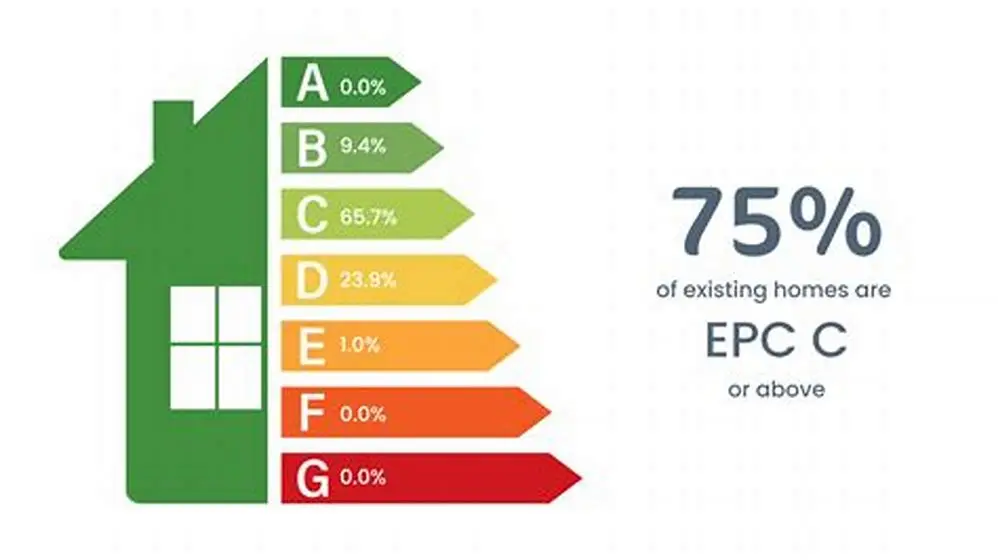
Most properties with oil heating sit in band D or E before the swap. The fuel factor shift alone can lift a borderline band E into band D, which matters for mortgage lending criteria and for grant schemes that exclude properties below a threshold. The band boundary typically sits around 55 points for a detached house and 60-65 for a semi-detached or terrace, though fabric and location shift those thresholds. For the detail, see our notes on energy rating for double glazed windows.
Efficiency differences between oil and LPG boilers
A modern condensing LPG boiler runs at 90 to 92% seasonal efficiency when sized and installed correctly. Older non-condensing oil boilers deliver 70 to 80%, and even a well-maintained condensing oil boiler rarely exceeds 85% in the field. The efficiency gap contributes the other half of the EPC gain. If you replace a 75% oil boiler with a 90% LPG unit, the efficiency jump multiplies the benefit from the fuel factor change.
Condensing technology recovers heat from flue gases by dropping the return temperature below the dewpoint of water vapour. LPG condenses more readily than oil because its flue gases contain more water vapour per unit of fuel. That gives LPG condensing boilers a slight edge in real-world efficiency, though the difference is only two to three percentage points compared to a condensing oil boiler. The bigger jump comes when the old oil boiler is non-condensing.
Oil boilers installed before 2005 are almost always non-condensing. Many still run at 70-75% efficiency, wasting a quarter of the fuel as hot flue gas. Replacing one of these with a 90% LPG condensing unit cuts fuel consumption by roughly 18% for the same heat output. The EPC calculation captures that reduction and converts it into points. The older and less efficient the existing oil boiler, the larger the EPC gain from the swap. People in this spot often ask about epc rating c for rental properties landlord rules as well.
Boiler efficiency also depends on system design. Oversized boilers cycle frequently and lose efficiency. A new LPG boiler should be sized to the heat loss of the property, ideally after insulation upgrades. An installer who replaces a 26 kW oil boiler with a 26 kW LPG unit without checking the load is missing the chance to right-size the system. A 20 kW unit might suffice and will run longer, more efficient cycles.
| Boiler type | Typical efficiency | Common installation period |
|---|---|---|
| Non-condensing oil | 70-80% | pre-2005 |
| Condensing oil | 82-85% | 2005-present |
| Non-condensing LPG | 75-82% | pre-2005 |
| Condensing LPG | 90-92% | 2005-present |
Typical EPC rating before and after oil to LPG boiler swap
A property with a 75% efficient oil boiler and moderate insulation might start at 52 points, sitting in band E. Swapping to a 90% LPG condensing boiler typically raises the score to 58-60 points, crossing into band D. The exact gain depends on the property's heat loss, floor area, and the efficiency of the old boiler. Larger, poorly insulated homes see smaller point gains per percentage of efficiency improvement because the heating demand dominates the calculation.
The fuel factor contributes roughly 3 to 4 points of that rise, and the efficiency gain adds another 3 to 5 points, giving a combined uplift of 6 to 9 points in a typical case. A property that starts at 48 points will reach 54-57, which may still fall short of band D if the fabric is poor. A property starting at 56 points will comfortably reach band C if other measures (controls, insulation, glazing) are already decent. There is more on are listed buildings exempt from epc rating in a separate guide.
Very old oil boilers running at 65-70% efficiency deliver the largest EPC gains when replaced. The efficiency jump from 70% to 90% is worth five to seven points on its own, and the fuel factor shift adds another three to four. Total gain can reach 10 points in a best case, enough to lift a band E into band C when the starting score is 52-54. Properties with newer condensing oil boilers see smaller gains because the efficiency gap is only five to seven percentage points.
The EPC model also rewards better controls. If the oil boiler had a basic programmer and room thermostat, and the new LPG system includes a weather compensator and thermostatic radiator valves, the controls upgrade can add another two to three points. Bundle the boiler swap with loft insulation or cavity wall fill, and you can push a mid-E property well into band C. The boiler alone rarely achieves that unless the starting efficiency was dire.
Why the fuel factor shift matters more than you expect
The fuel factor difference between oil and LPG is only 0.154, but it multiplies every kilowatt-hour of heating demand. A property using 20,000 kWh of heating per year will see that demand weighted by the fuel factor before the EPC cost is calculated. Switching from oil's 1.326 to LPG's 1.172 reduces the weighted demand by 1,848 kWh, equivalent to a real saving of about £140 per year at typical fuel prices in the EPC's default cost table. That saving feeds directly into the EPC score. We go through house EPC rating thresholds step by step elsewhere on the site.
The EPC model does not use your actual fuel tariff. It uses a standardised pence-per-kWh figure for each fuel, updated quarterly. As of late 2026, the model assumes oil costs around 6.2p per kWh delivered and LPG around 7.8p per kWh, but the fuel factors adjust those figures to reflect carbon intensity. The final cost and carbon scores favour LPG despite its higher nominal price. In practice, delivered LPG often costs 8-10p per kWh depending on tank size and location, while oil fluctuates between 5.5p and 7p. Your bills may not match the EPC's prediction.
The fuel factor also affects the Environmental Impact score, which runs alongside the Energy Efficiency score on every EPC. Switching to LPG raises the Environmental Impact by 8 to 12 points because of the lower carbon factor. Landlords targeting Minimum Energy Efficiency Standards (MEES) care about the Energy Efficiency score, while mortgage lenders and grant schemes sometimes reference both. A band D on energy efficiency but band E on environmental impact is still compliant, but some lenders prefer both scores in band D or better.
If your property sits on mains gas, the fuel factor drops further to 1.030, and the EPC gain would be larger still. But oil properties are almost always off-grid, so LPG or a heat pump are the realistic swaps. Heat pumps carry a fuel factor of 0.856 for electricity, which sounds attractive, but the coefficient of performance (COP) complicates the comparison. A heat pump with a seasonal COP of 3.0 delivers three units of heat per unit of electricity, so the effective factor becomes 0.856 ÷ 3.0 = 0.285, far better than LPG. That explains why heat pumps dominate band A and B ratings.
Implications for grants and funding eligibility
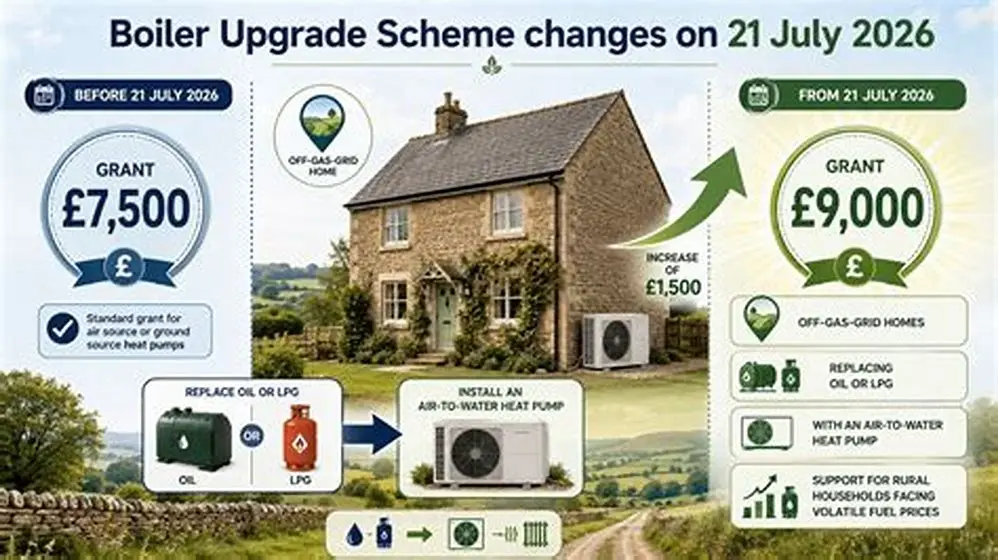
The Boiler Upgrade Scheme offers £7,500 towards an air-source heat pump but nothing for fossil-fuel boiler replacements. ECO4 funding can cover boiler upgrades for low-income households, but only when the property sits in band D, E, F or G and the household receives qualifying benefits. A swap that lifts you from band E to band D keeps you eligible for other ECO4 measures (insulation, glazing, ventilation) but a jump to band C may close the door unless you qualify on income grounds alone.
Mortgage lenders increasingly require band C or better for new lending or remortgaging on older properties. A property stuck in band E may face valuation penalties or higher interest rates. Lifting the rating to band D removes that barrier, and reaching band C opens access to green mortgage products with lower rates. The oil-to-LPG swap alone rarely reaches band C unless the fabric is already sound, but it positions the property for a second round of improvements (loft top-up, room-in-roof insulation, secondary glazing) that complete the journey.
Private rental properties must reach band E by law, and the threshold rises to band C by 2028 under proposed regulations. A band F property with an ancient oil boiler can reach band E with a new LPG boiler and basic insulation, meeting the current standard. But the landlord will need further work (solar panels, external wall insulation, a heat pump) to hit band C. The LPG boiler becomes a stepping stone rather than a final answer, buying time and spreading the capital outlay.
Some local authorities and energy suppliers run regional schemes that fund low-carbon heating for off-grid homes. These schemes typically require an EPC assessment before and after the work to verify the improvement. The post-installation EPC must be lodged on the official register within six months, or the grant may be clawed back. Book the assessor before the old boiler is removed, so the baseline is captured accurately, then arrange a return visit once the new system has been commissioned and any controls or insulation work completed.
- Boiler Upgrade Scheme: no grant for LPG boilers, £7,500 for heat pumps only
- ECO4: covers boiler upgrades for low-income households in bands D-G with qualifying benefits
- Green mortgages: band C or better unlocks lower rates from most lenders
- Private rental: band E now, band C by 2028 under proposed rules
Getting the new rating recorded
An EPC lasts ten years, but a boiler replacement is a notifiable change that warrants a new assessment if you need proof of the improvement. The old EPC remains valid for legal purposes (selling, renting) but mortgage lenders and grant administrators will ask for an updated certificate showing the new boiler. Book a Domestic Energy Assessor (DEA) once the installation is complete and the system has been running for a week or two, so the commissioning data is available.
The assessor will inspect the boiler, photograph the data badge, check the controls, and measure the property if the floor plan has changed. The new EPC will show the LPG boiler's efficiency, the fuel type, and the revised energy and environmental scores. The certificate must be lodged on the official register at epcregister.com within five days of issue. Lenders and grant schemes query the register directly, so an unlodged certificate is invisible to them even if you hold a paper copy.
The assessment costs £60 to £120 depending on property size and location. Rural properties and those over 200 square metres sit at the higher end. Some installers bundle the EPC cost into the boiler quote, though you remain responsible for booking the assessor and ensuring the certificate is lodged. If the score is lower than expected, the assessor can explain which elements (fabric, glazing, controls) are holding it back and what further improvements would yield the next band.
Check the certificate for errors before it is lodged. Floor area, wall construction, and glazing type are common mistakes, and each one can cost several EPC points. If the assessor records your double glazing as single-glazed, or logs your cavity walls as solid, challenge it immediately. Once lodged, correcting an EPC requires a formal complaint and re-assessment, which delays grant applications and mortgage offers. The assessor's site notes should match what you see in the property.
Questions people still ask
Will replacing my oil boiler with LPG reduce my fuel bills?
Your bills depend on the delivered price of each fuel, which varies by location and tank size. LPG often costs more per kWh than oil, so the efficiency gain from a new condensing boiler may only offset the fuel price difference rather than cutting bills. The EPC improvement reflects the model's standardised costs, not your actual tariff.
Can I get a grant to replace an oil boiler with LPG?
The Boiler Upgrade Scheme does not cover fossil-fuel boilers. ECO4 may fund the swap if you receive qualifying benefits and your property sits in band D, E, F or G. Local authority schemes occasionally cover off-grid homes, so check your council's website or contact an ECO4 installer.
How long does an LPG boiler last compared to an oil boiler?
Both typically last 12 to 15 years with annual servicing. LPG boilers see slightly less soot and deposit buildup, which can extend intervals between major services, but lifespan depends more on installation quality and maintenance than fuel type.
Does switching to LPG require planning permission?
The boiler swap itself does not need planning permission, but an external LPG tank may require approval if it sits within one metre of a boundary or in a conservation area. Check with your council before ordering the tank. Buried tanks usually avoid planning issues.
Will my EPC score drop again when the LPG boiler ages?
The EPC assumes new boilers run at their rated efficiency and does not degrade the score as the boiler ages. Your score stays constant until you fit a different heating system or improve the fabric. Real-world efficiency will decline without annual servicing, but the certificate does not track that.