Triple glazing usually costs £500-700 per m² fitted in the UK, against £350-450 for double. The third pane adds roughly 25-45% to the bill, and how far that premium goes depends on what your wall, loft and draughts already achieve.
On this page
- Quick recap
- What triple glazing costs per m², and why quotes hide it
- What drives the premium besides the extra pane
- The U-value figures to ask for, and why the numbers keep sliding
- Do the fabric first, or the third pane is wasted
- Reading a per-m² quote so two fitters can be compared
- Where the third pane never returns its cost
- Quick questions
Part of our guide on typical triple glazing costs
Quick facts
- Double glazing
- £350-450 per m² fitted
- Triple glazing
- £500-700 per m² fitted
- Typical triple premium
- 25-45% over double
- Uw to ask for, triple
- 0.8-1.0 W/m²K
- Uw to ask for, double
- 1.2-1.4 W/m²K
- Frame depth needed
- 70-90 mm, sometimes more
Quick recap
- Get both quotes priced per m² on the same specification, or the comparison is meaningless.
- The third pane drops whole-window Uw by roughly 0.2 to 0.4 W/m²K, not to zero.
- If the wall is uninsulated, spend the glazing premium on the wall first.
- Small and north-facing windows rarely return the triple premium.
- No current UK grant pays for glazing. Check rated glazing and draughts on the EPC instead.
What triple glazing costs per m², and why quotes hide it
The per-window price quoted over the phone rarely relates to per-m² cost. Fitters quote per window because a small window costs almost as much to make and fit as a large one, so the £/m² figure on a compact casement can be double what a 1.5 m² unit costs. That makes it easy to compare the wrong numbers.
Double glazing typically lands at £350-450 per m² fitted, depending on frame material, glass specification and where you are in the UK. Triple runs £500-700 per m² fitted. The gap is the figure you are actually judging: usually £100-200 per m², or roughly 25-45% on top.
Ask every fitter for the same breakdown: total area in m², total quote, and price per m². Any quote that gives one figure and not the other is not comparable to anything. A 400 mm wide window costs a fortune per m² and almost nothing in absolute terms.
The premium per m² rises on smaller windows because the frame and hardware cost is fixed. It falls on larger fixed panes because glass dominates. Two 1.8 m x 1.2 m units will price better per m² than four 0.9 m x 1.2 m ones in the same room. Before you commit to anything, it is worth looking at u value differences at 16mm gap.
| Specification | Typical fitted £/m² | Whole-window Uw | Heavier? |
|---|---|---|---|
| Standard double, 28 mm | £350-450 | 1.2-1.4 W/m²K | No |
| High-spec double, argon, warm edge | £400-500 | 1.0-1.2 W/m²K | Slightly |
| Triple, 36-44 mm unit | £500-700 | 0.8-1.0 W/m²K | Yes |
| Triple, passive-house spec | £700-1,000+ | 0.6-0.8 W/m²K | Yes, significantly |
What drives the premium besides the extra pane
The third pane is not what costs the money. The glass itself adds perhaps 20-35% to the glazing unit cost, which is often the smallest line in the quote. What drives the bill is everything the extra pane forces around it.
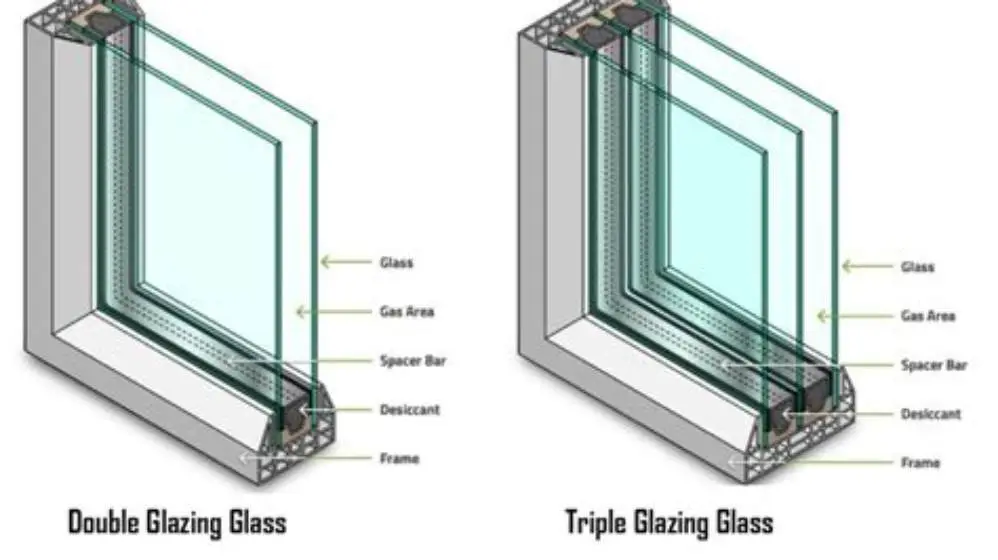
A triple unit is 36-44 mm thick, sometimes more. That means the frame profile has to be deeper, 70-90 mm rather than 60-70 mm. It weighs more, so hinges, restrictors, handles and lock hardware all upgrade. The glazing bead and rebate change. If you have draughty timber sashes, the whole sash may need remaking, not just reglazing.
Fitting labour rises too. Heavier units need two or three people instead of one. Reveals may need trimming, sills replaced, and sometimes structural work to accommodate the deeper frame. On a listed or conservation-area property, the profile restrictions can add fittings and drawings on top. It helps to understand how glazing affects home energy ratings before going further.
- Frame depth: 70-90 mm for triple, against 60-70 mm for double.
- Hardware: heavier hinges, restrictors and espagnolette handles rated for the load.
- Glazing bead and rebate: different profile, sometimes a factory option only.
- Fitting labour: two-person lifts, and often a longer install day per window.
The U-value figures to ask for, and why the numbers keep sliding
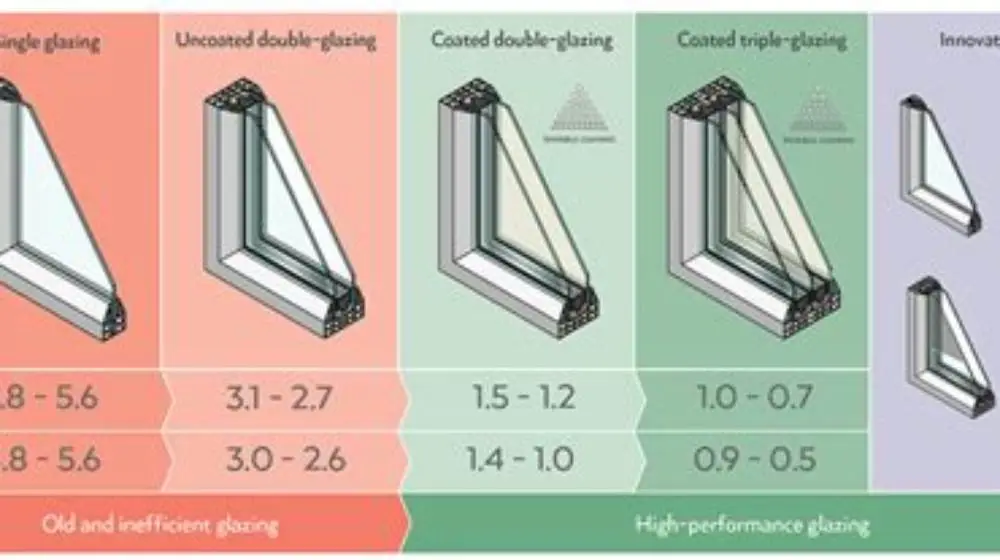
Two numbers matter and they are not the same. Ug is the centre-pane value, measuring the glass only. Uw is the whole-window value, counting frame, spacer and edge effects. Uw is always worse than Ug, and it is the number that goes on the EPC.
A good triple unit can hit Ug of 0.5-0.7 W/m²K in the centre. The same window's Uw usually sits at 0.8-1.0 once you include the frame. High-spec double hits Uw of 1.2-1.4 in most domestic frames. The gap between them is real, but it is measured in tenths, not in halves.
Ask for both figures in writing on the quote, with the UK standard test method named. Any fitter who cannot state the Uw of what they are selling cannot be compared against another who can. The number depends on the unit thickness, gas fill, spacer type and frame material, so it moves with every choice.
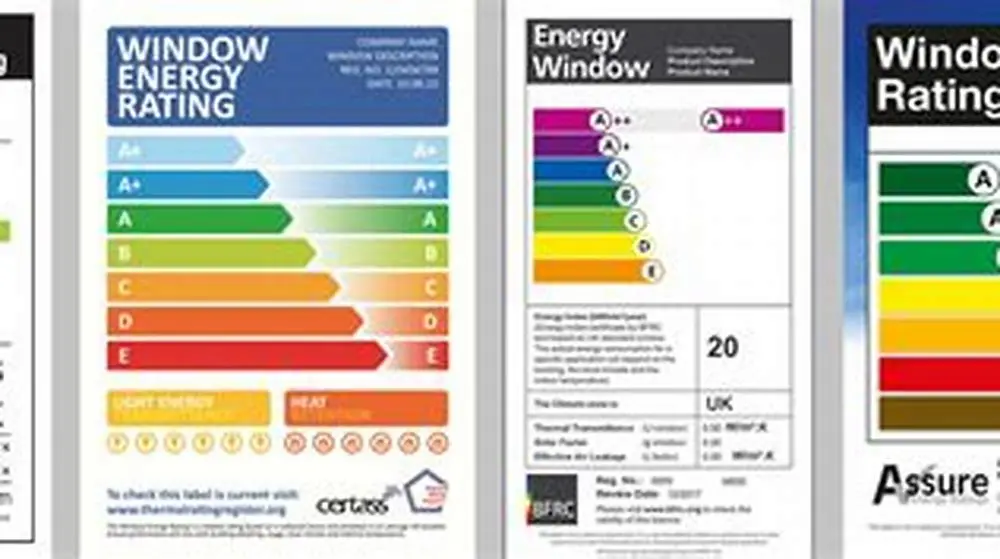
For a whole-house view, the EPC uses these values to model heat loss. Improving Uw from 1.4 to 0.9 on a house with 20 m² of glazing saves roughly the same heat as upgrading from single to double on the same area. On a house that already has double, it is a smaller step.
Do the fabric first, or the third pane is wasted
Triple glazing on a poorly insulated house is like fitting a new front door to a house with no roof. The window improves, the house does not. Every joule you save through the glass leaks out through the loft hatch and the suspended floor.
The order that works is: draughts, loft, walls, then windows. Draught-proofing chimneys, lofts and doors costs tens of pounds and often saves more heat than a full window replacement. Loft insulation to 270 mm is the current recommended depth on top of the joists. Cavity wall insulation, where suitable, is the biggest single fabric win on older UK homes.
Only after those does the glazing premium pay its way. If your walls are solid brick with no insulation, adding 100 mm of internal or external wall insulation drops the wall U-value from around 2.1 to 0.3 W/m²K. The window, even at Uw 0.9, is then by far the weakest element. Fix the wall first, then decide whether 0.9 against 1.2 on the window is still worth the money.
- Draught-proof doors, lofts, chimneys and floor edges. Cost: tens of pounds, high return.
- Top up loft insulation to 270 mm. Cost: hundreds, very high return.
- Insulate walls by cavity fill or solid-wall method, if applicable. Cost: thousands, high return.
- Replace glazing only when the fabric is done, and only on the windows that matter.
Reading a per-m² quote so two fitters can be compared
Two quotes only compare if they contain the same items. A low per-m² figure often excludes removal and disposal of the old units, VAT, making good the plaster reveals, or the sill. Each of those can add £100-300 per window, which changes the verdict.
Ask for the quote as a table of line items: glass specification with Ug, frame material and Uw, hardware, fitting, removal, making good, VAT. If any line is missing, ask for it. If a fitter refuses to separate them, that is the answer you need about the fitter.
Check the m² figure against the window sizes: 1.5 m² for a 1.5 m wide by 1 m high unit. Measure the structural opening, not the glass, and note whether the quote uses opening or overall dimensions. The difference on a small window can be 15-20% on the m², which is why two fitters can look 30% apart with the same prices.
| Quote line | Double example | Triple example | Why it matters |
|---|---|---|---|
| Glass spec with Ug | Ug 1.1 | Ug 0.5 | Drives the Uw, not the price alone |
| Frame and Uw | Uw 1.3 | Uw 0.9 | Reduces heat loss and EPC score |
| Fitting and removal | Included | Included? | Missing this is common |
| VAT at 20% | Listed | Listed? | Adds thousands on a full house |
Where the third pane never returns its cost
Two situations make the triple premium a bad buy. Small windows, and windows on north walls that already lose less heat than the wall around them. Both are common, and both are ignored in showroom comparisons.
A 0.5 m² bathroom window costs little in absolute money, but the £/m² is high because the frame dominates. The extra £100-200 the triple pane adds buys you a Uw improvement of about 0.3 W/m²K on a small opening. Over a year, on typical gas heating, that is a few pounds. It will not repay in the lifetime of the window.
Orientation matters because south and west windows gain solar heat that offsets some of their losses when the sun is out. On those, going to a lower Uw can actually reduce net benefit if the glazing specification blocks solar gain. North and east windows have little solar gain, so a lower Uw helps more. West windows in overheating-prone homes are the case where triple is sometimes wrong on comfort grounds as well as cost.
The break-even point sits where the wall U-value is close to the window Uw. If the wall is around 0.3 and the window is 1.2, the window is four times leakier and the third pane is worth it. If the wall is 2.1 and the window is 1.2, the window is the good part and the money belongs in the wall.
- lower Uw, warmer inner pane
- quieter against road noise
- less condensation on the glass
- better EPC glazing score
- £100-200 per m² more
- heavier, deeper frame
- may block useful solar gain
- poor value on small windows
Triple glazing is worth the premium only where the wall, loft and draughts are already fixed, and on the rooms where the window is the weakest element left.
Quick questions
Is there any grant that pays for glazing in the UK?
No current national grant pays directly for glazing. The Boiler Upgrade Scheme and ECO4 cover heating and insulation measures, not windows. Glazing improvements help your EPC score, so if a future scheme is tied to an EPC band, better Uw values count in your favour. Check the current EPC for your home and see whether glazing appears as a recommended measure.
What Uw should I ask for on a triple-glazed quote?
Ask for Uw of 0.8-1.0 W/m²K on standard triple, and Ug of 0.5-0.7 W/m²K. The exact figure depends on frame material, unit thickness and spacer type, so ask for it in writing on the quote with the test standard named. Any figure without the conditions is a marketing number, not a specification.
Will triple glazing pay for itself in lower bills?
Not on most UK homes replacing existing double glazing. The Uw improvement of around 0.3-0.4 W/m²K rarely repays a £100-200 per m² premium inside the window's life, unless the house is poorly insulated elsewhere and the window is the only element you can change. Where walls are already insulated, the third pane pays better because the window becomes the dominant loss.
How do I compare two glazing quotes properly?
Ask both fitters for a line-item quote including glass Ug, frame Uw, hardware, fitting, removal and disposal, making good, and VAT. Then divide the total by the m² of structural opening. That is the only figure that compares. If a fitter cannot separate the lines, that tells you how the job will be managed.
Should I replace windows in a listed building, or can I reglaze?
Reglazing an existing timber frame with slim double or vacuum glazing is usually the only route on a listed building, and it may be cheaper than full replacement because you keep the frame. Check with your conservation officer first, because some profiles and glazing types are not permitted. Where reglazing is allowed, the premium over ordinary double is often smaller than the full triple replacement.