Find out how much your EPC rating improves when you fit an insulated hot water cylinder and what factors determine the score change.
An insulated hot water tank typically adds 1 to 3 SAP points to your EPC score. The exact gain depends on the cylinder's insulation thickness, your existing setup, and heating fuel. Band improvements from F to E or E to D are common.
On this page
- The short version
- How much your EPC score rises with an insulated tank
- How EPC assessment treats hot water tanks
- Factory insulation versus retrofit jackets
- Why insulation thickness drives the SAP calculation
- Examples of typical EPC rating changes after installation
- When an insulated cylinder won't shift your band
- Questions people still ask
Part of our guide on saving energy with EPC improvements
Most installers won't tell you the precise SAP gain before the work is done, but the jump from a bare copper cylinder can push a borderline property across a band threshold.
| Typical SAP gain | 1–3 points |
|---|---|
| Heat loss reduction | 50–80% vs bare copper |
| Factory insulation | 50–80 mm polyurethane |
| Retrofit jacket | 25–40 mm mineral fibre |
| Common band shift | F to E or E to D |
| Payback period | 2–4 years on bills |
The short version
- Insulated cylinders reduce standing heat loss by 50–80% compared to uninsulated tanks, directly raising SAP points
- Typical EPC gain is 1–3 SAP points; band changes are most likely near thresholds like 38 or 54 points
- Factory-sprayed foam at 50–80 mm outperforms retrofit jackets at 25–40 mm
- Oil and LPG heating see larger gains than gas because fuel cost weighting is higher in SAP calculations
- An upgrade from a single-skin copper cylinder to a modern insulated model can shift a property from band F to E
How much your EPC score rises with an insulated tank
An insulated hot water cylinder adds 1 to 3 SAP points in most homes. That range reflects differences in cylinder size, insulation thickness, heating fuel and the rest of your heating system. A property sitting at 37 points (just inside band F) can cross into band E at 39 points with a well-insulated cylinder and one other small improvement. The jump from E to D at 55 points is harder because you need more cumulative gains, but an insulated tank still contributes its share.
The SAP calculation treats hot water storage as a standing heat loss measured in kWh per day. A bare copper cylinder loses 3 to 5 kWh/24h. A factory-insulated model with 50 mm of polyurethane loses 0.7 to 1.2 kWh/24h. That difference, multiplied by 365 days and the fuel cost factor, translates directly into SAP points. Gas heating sees smaller gains because gas is cheaper per kWh in the SAP tariff. Oil and LPG properties see larger point increases (sometimes 4 points) because those fuels carry higher cost weightings.
Real examples from lodged EPCs show a mid-terrace house moving from 36 (band F) to 40 (band E) after fitting a 150-litre insulated cylinder and upgrading loft insulation to 270 mm. A detached 1960s property on oil went from 42 (band E) to 47 (band E) with the cylinder alone, then crossed into band D at 55 after adding cavity wall insulation. The cylinder contributed roughly 2 points in the first case and 3 points in the second.
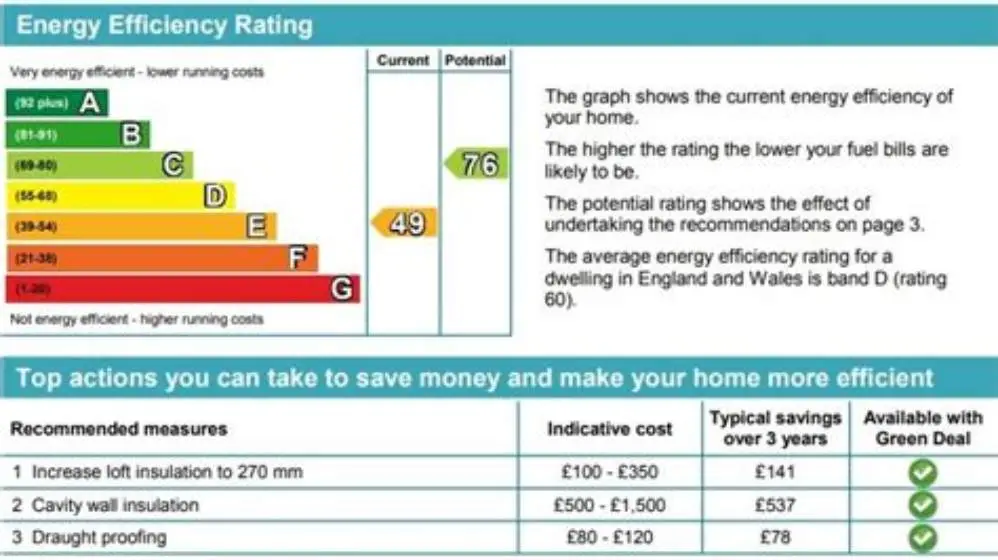
If your property sits within 2 or 3 points of a band threshold, an insulated cylinder can be the single measure that tips you over. If you're 10 points away, you'll need it plus other fabric or heating improvements. Check your current EPC certificate for the SAP score (it's printed on page two) and measure the gap to the next band. Before you commit to anything, it is worth looking at effect on epc replacing oil boiler.
| Heating fuel | Old cylinder type | New cylinder insulation | Typical SAP gain |
|---|---|---|---|
| Mains gas | Bare copper | 50 mm factory foam | 1–2 points |
| LPG | Bare copper | 50 mm factory foam | 2–3 points |
| Oil | Bare copper | 80 mm factory foam | 3–4 points |
| Electric immersion | Bare copper | 50 mm factory foam | 1–2 points |
How EPC assessment treats hot water tanks
The EPC assessor records the cylinder type, insulation thickness and whether it has a factory-applied jacket or a retrofit wrap. That information feeds into the standing heat loss figure in the SAP worksheet. The software looks up a loss rate from a table indexed by insulation thickness and cylinder volume. A 150-litre uninsulated cylinder is assigned a loss of around 3.8 kWh/24h. The same cylinder with 50 mm of spray foam drops to 1.0 kWh/24h.
The assessor measures insulation by eye or by pressing the jacket to estimate thickness. Factory foam is easy to assess because the data plate states the specification. Retrofit jackets are harder: assessors assume 25 mm unless the jacket is visibly thicker or you can show proof of a higher-grade product. If you fitted an 80 mm jacket yourself, keep the packaging or receipt so the assessor can record the correct value.
Cylinder location matters less than insulation thickness, but a tank in a heated space (like an airing cupboard inside the thermal envelope) loses marginally less heat to the outside. The SAP calculation accounts for this through the heat loss distribution factor. A cylinder in an unheated garage or loft is penalised slightly more because all the standing loss counts as wasted energy. Most cylinders sit in heated spaces, so the effect is minor compared to the insulation itself. For the detail, see our notes on heat pump epc rating improvement.
The assessor also checks whether the cylinder has a thermostat and how it integrates with the boiler or immersion heater. A cylinder stat set to 60 °C with a timer reduces overheating losses. These controls add a small SAP credit, but the insulation upgrade is worth ten times more in point terms.
Factory insulation versus retrofit jackets
Factory-insulated cylinders carry 50 to 80 mm of rigid polyurethane foam sprayed between the inner tank and an outer steel skin. The foam is continuous, with no seams or gaps, and delivers a standing heat loss under 1.2 kWh/24h for a 150-litre cylinder. These cylinders are the standard in new builds and full heating system replacements. They cost £300 to £600 depending on capacity and coil configuration, plus fitting.
Retrofit jackets wrap around an existing bare cylinder. They're made from mineral fibre or recycled plastic fleece and come in 25 to 40 mm thicknesses. A 25 mm jacket reduces heat loss by around 50%, bringing a bare copper cylinder from 3.8 down to 1.9 kWh/24h. A 40 mm jacket gets you to 1.4 kWh/24h, close to factory foam performance. Jackets cost £15 to £40 and take ten minutes to fit. They're a quick win if your cylinder is otherwise sound, but they don't match the thermal performance of integral foam. We cover typical insulation values for double glazing in its own article.
The SAP uplift reflects this gap. A factory-insulated cylinder typically adds 2 to 3 points over a bare tank. A 40 mm retrofit jacket adds 1 to 2 points. If your cylinder is corroded, undersized or incompatible with your heating controls, replace it with a factory-insulated model. If it's in good condition and you're chasing every SAP point on a tight budget, a thick retrofit jacket is a cost-effective first step.
One edge case: if you're installing a heat pump, you'll need a larger cylinder with a bigger coil area anyway. That's the moment to specify a high-performance factory-insulated model with 80 mm of foam. The SAP gain stacks with the heat pump's own efficiency credit, and you avoid a second cylinder swap later.
- Factory foam: 50–80 mm rigid polyurethane, heat loss 0.7–1.2 kWh/24h, SAP gain 2–3 points, cost £300–£600 fitted
- Retrofit jacket: 25–40 mm mineral fibre, heat loss 1.4–1.9 kWh/24h, SAP gain 1–2 points, cost £15–£40 DIY
Why insulation thickness drives the SAP calculation
The SAP model calculates annual hot water energy use by adding the useful energy delivered to taps and the heat lost from the cylinder and pipework. Cylinder standing loss is the heat that escapes through the jacket while the water sits idle. It's measured in kWh/24h and depends on the temperature difference between stored water (usually 60 °C) and the surrounding air, typically 15 to 20 °C in an airing cupboard. We go through epc rating exemption for listed buildings step by step elsewhere on the site.
Thermal conductivity of the insulation material determines the loss rate. Polyurethane foam has a conductivity around 0.022 W/m·K. Mineral fibre sits at 0.035 W/m·K, so you need more thickness to achieve the same resistance. The SAP lookup tables convert insulation thickness into a U-value for the cylinder surface, then calculate daily heat loss. Doubling the insulation thickness roughly halves the heat loss, but you hit diminishing returns above 80 mm because the surface area increases with each added layer.
The annual standing loss feeds into the primary energy calculation, which weights fuel by carbon intensity and cost. Gas at 10 p/kWh is multiplied by a primary energy factor of around 1.1. Oil at 14 p/kWh (effective SAP tariff) gets a factor near 1.4. That's why the same physical heat loss from a cylinder costs more SAP points on oil than on gas. Electric immersion heating carries the highest carbon factor (around 2.5) but most properties with immersion also have gas or oil as the primary heating fuel, so the standing loss is attributed to the cheaper fuel in the calculation.
EPC software rounds SAP scores to whole numbers, so a gain of 1.4 points might show as 1 or 2 depending on where you started. If your property sits at 38.3 and the cylinder adds 1.6 points, you'll land at 39.9, which rounds to 40: just over the band E threshold. That rounding can make or break a band change. If that sounds like your situation, read up on how to check the epc rating of a property next.
Examples of typical EPC rating changes after installation
A 1970s end-terrace in the Midlands with mains gas heating scored 38 points (band F) before retrofit. The property had 100 mm of loft insulation, single glazing and a bare copper cylinder. The owner fitted a 150-litre factory-insulated cylinder with 50 mm foam, upgraded the loft to 270 mm and replaced six windows. The new EPC came back at 54 points (band E). The cylinder contributed roughly 2 points of that 16-point gain, with loft and glazing doing the rest.
A detached 1930s house on oil in the South West started at 42 points (band E). It had cavity walls, 200 mm of loft insulation and an uninsulated 180-litre cylinder. The owner replaced the cylinder with a modern 210-litre model insulated to 80 mm. The new certificate showed 46 points (band E): a 4-point gain from the cylinder alone. Adding cavity wall insulation later pushed the property to 58 points and band D.
A Victorian terrace in the North with LPG heating sat at 35 points (band F). Solid walls, 50 mm of loft insulation and a bare cylinder. The owner fitted a 40 mm retrofit jacket and added 100 mm of loft roll on top of the existing layer. The EPC improved to 39 points (band E). The jacket added 1 point, and the loft insulation added the rest. The owner chose the jacket over a full cylinder replacement because the existing tank was only five years old and in good condition.
In each case, the cylinder upgrade alone rarely crosses a band threshold unless the property is already close. The real value comes when you pair it with one or two other fabric measures. The cylinder is often the cheapest of those measures per SAP point, especially if you're replacing an old tank anyway.
| Property type | Heating fuel | Starting EPC | Cylinder upgrade | Other measures | Final EPC | Cylinder SAP gain |
|---|---|---|---|---|---|---|
| 1970s end-terrace | Mains gas | 38 (F) | 50 mm factory foam | Loft to 270 mm, 6 windows | 54 (E) | ~2 points |
| 1930s detached | Oil | 42 (E) | 80 mm factory foam | None initially | 46 (E) | ~4 points |
| Victorian terrace | LPG | 35 (F) | 40 mm retrofit jacket | Loft to 150 mm | 39 (E) | ~1 point |
When an insulated cylinder won't shift your band
If your property sits 10 or more SAP points below the next band threshold, a cylinder upgrade alone won't get you there. A house at 44 points needs to reach 55 for band D. The cylinder adds 2 or 3 points, leaving a 7- to 8-point gap. You'll need wall insulation, glazing upgrades or a heating system change to close that distance. The cylinder is still worth doing (it cuts bills and contributes to the cumulative gain) but it's not the single measure that delivers the band shift.
Properties with existing good insulation see smaller gains because the cylinder is no longer the weakest link. A house with 300 mm of loft insulation, filled cavities and a modern condensing boiler might already score 65 (band D) with a bare cylinder. Adding insulation lifts it to 67, still band D. The fuel saving is real, but the SAP impact is diluted by the rest of the efficient fabric.
Flats and maisonettes often score higher than houses because the heated floor area is smaller and shared walls reduce heat loss. A flat at 58 points with a bare cylinder might rise to 60 after an upgrade: a 2-point gain that doesn't cross the band D/C threshold at 69. The percentage improvement in running cost is still worthwhile, but the certificate band stays put.
If your EPC is already band C or above, the cylinder insulation becomes a maintenance and comfort decision rather than a rating driver. SAP points above 70 are harder to gain because you're chasing diminishing returns on an already efficient property. At that level, focus on heating controls, solar thermal or a heat pump if you want further carbon and cost reductions.
Questions people still ask
Does a hot water cylinder need a certain insulation thickness to count on an EPC?
Any measurable insulation counts, but the SAP tables differentiate by thickness. A 25 mm jacket is credited with roughly half the heat loss reduction of 50 mm factory foam. Assessors default to 25 mm unless you can show proof of a thicker jacket. Factory-insulated cylinders carry a data plate stating the foam thickness, so they're straightforward to assess.
Will an insulated cylinder improve my EPC if I have a combi boiler?
Combi boilers heat water on demand and don't use a storage cylinder, so there's no cylinder standing loss in the SAP calculation. An insulated cylinder only affects EPC scores on systems with a hot water tank: conventional boilers with separate cylinders, heat pumps with buffer tanks, or electric immersion systems.
Can I fit a retrofit jacket myself and still get the EPC credit?
Yes. The assessor records whatever insulation is in place at the time of the survey, regardless of who fitted it. Keep the packaging or receipt so you can show the jacket thickness if the assessor asks. A well-fitted 40 mm jacket delivers most of the SAP benefit of factory foam at a fraction of the cost.
How long after installation should I wait before booking a new EPC?
You can book the assessment as soon as the cylinder is installed and the system is commissioned. The assessor needs to see the new cylinder in place and confirm the insulation specification. There's no waiting period, but make sure any other planned measures (loft insulation, glazing) are also complete if you want them included in the same certificate.
Does upgrading from a 120-litre to a 180-litre cylinder affect the SAP score?
A larger cylinder has more surface area, so standing heat loss rises slightly even with the same insulation thickness. The SAP calculation accounts for volume in the lookup table. If you're replacing a small uninsulated cylinder with a larger factory-insulated one, the insulation benefit far outweighs the size penalty. But upsizing from 150 to 250 litres with the same insulation may reduce the net SAP gain by a fraction of a point.