Heat pumps pull warmth from cold air using refrigerant that boils far below freezing, capturing energy invisible to touch but real in physics.
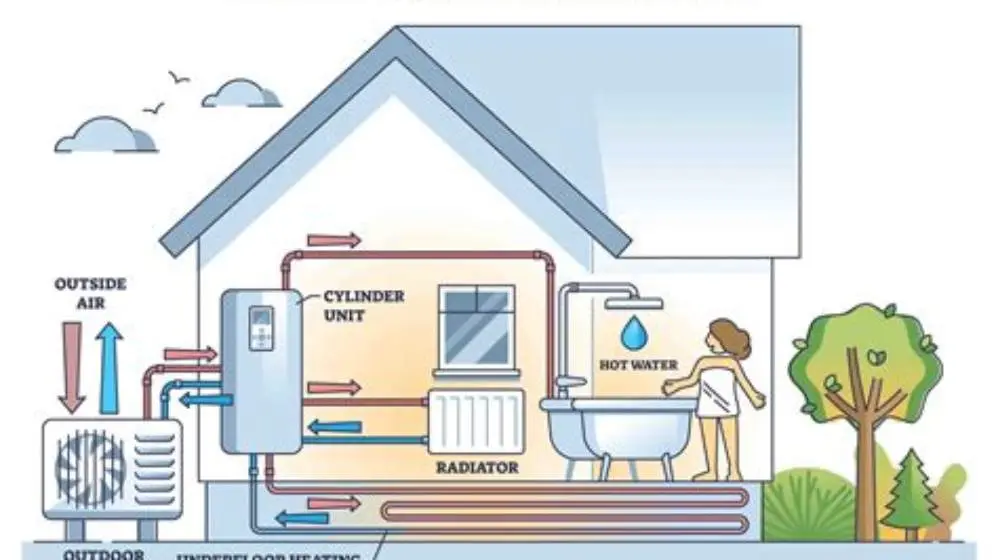
Heat pumps extract warmth from cold air using refrigerant that evaporates at temperatures well below freezing: often around -20°C to -30°C. Even air at 0°C holds thermal energy relative to that refrigerant, so heat flows from air into the coils, boiling the refrigerant and capturing energy that is then compressed to 50°C to 65°C for your radiators or underfloor heating.
On this page
- The short version
- Why cold air still contains heat energy
- How heat pumps absorb heat from cold air
- The refrigeration cycle basics relevant to this process
- Key heat pump components involved in heat absorption
- Why heat extraction works efficiently to minus fifteen degrees
- What happens when outdoor temperature drops below design limits
- Questions people still ask
Part of our guide on installer advice for heat pumps
Cold air at zero degrees still holds enough thermal energy to heat your home to twenty degrees, because cold is relative and refrigerant boils at minus thirty.
| Refrigerant boiling point | -20°C to -30°C at low pressure |
|---|---|
| Outdoor air heat threshold | Works down to -15°C efficiently |
| Compressed output temp | 50°C to 65°C for heating |
| Heat in 0°C air | 273 kJ/kg above absolute zero |
| Typical COP at -5°C | 2.0 to 2.5 (falling with cold) |
The short version
- Refrigerant evaporates at
-20°Cto-30°C, so air at0°Cis warm enough to boil it and transfer heat into the system. - The compressor raises refrigerant temperature from around
-10°Cto 50-65°C, delivering usable heat to radiators or underfloor loops. - Heat pumps work efficiently down to
-15°Coutdoor temperature; below that, performance drops but extraction continues. - The refrigeration cycle mirrors a fridge in reverse: absorb heat outside, release it inside.
- Larger evaporator coils and variable-speed fans improve heat capture when outdoor air is very cold.
Why cold air still contains heat energy
Air at 0°C feels cold to your skin, but thermodynamically it is 273 degrees above absolute zero (-273°C), the point where molecular motion stops. Every degree above absolute zero represents thermal energy that can be extracted if you have a substance colder than the air itself. Heat pumps exploit this by circulating refrigerant that remains liquid and then evaporates at temperatures far below freezing: typically -20°C to -30°C depending on pressure and refrigerant type. When outdoor air meets the evaporator coil filled with this super-cold refrigerant, heat flows from the relatively warmer air into the refrigerant, even when that air registers below freezing on a normal thermometer.
The trick is that heat always moves from warmer to cooler, and "warm" is relative. A winter morning at -3°C is seventeen degrees warmer than refrigerant circulating at -20°C, so heat transfers naturally from air to coil. The refrigerant absorbs that energy, evaporates into a gas, and carries the captured warmth toward the compressor. This is why heat pumps can extract useful energy from air temperatures that would freeze water solid.
The amount of extractable energy falls as outdoor temperature drops, because the temperature difference between air and refrigerant shrinks. At -15°C outdoor, the gap is only five degrees if refrigerant is at -20°C, so heat flow slows and the evaporator must work harder (larger coils, faster fans) to gather the same quantity of energy. Most air-source heat pumps maintain a coefficient of performance (COP) of 2.0 to 2.5 at -5°C, meaning every kilowatt of electricity delivers two to two-and-a-half kilowatts of heat. Below -10°C, COP drops toward 1.5 to 2.0, and supplementary heating or a backup immersion may be needed on the coldest nights.
| Outdoor air temp | Energy above absolute zero | Typical COP | Notes |
|---|---|---|---|
10°C | 283 kJ/kg | 3.0–4.0 | High efficiency, minimal defrost cycles |
0°C | 273 kJ/kg | 2.5–3.0 | Moderate efficiency, occasional defrost |
-5°C | 268 kJ/kg | 2.0–2.5 | Performance drops, more defrost needed |
-10°C | 263 kJ/kg | 1.8–2.2 | Efficiency falls, backup heat may activate |
-15°C | 258 kJ/kg | 1.5–2.0 | Lower limit for most UK air-source pumps |
How heat pumps absorb heat from cold air
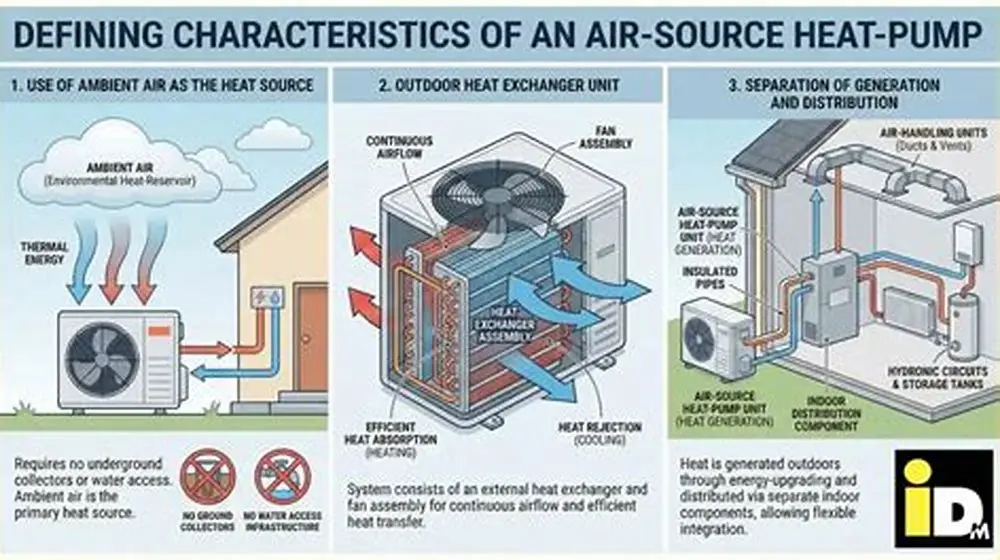
The absorption happens in the evaporator coil, a finned metal assembly mounted in the outdoor unit. Liquid refrigerant enters this coil at low pressure, which lowers its boiling point to around -25°C. As outdoor air (even at 0°C) passes over the fins, heat flows from air into refrigerant. The refrigerant absorbs that energy and evaporates into a low-pressure gas. Evaporation is an endothermic process: it consumes heat from the surroundings. This is why the coil surface becomes colder than the ambient air, often forming frost when humidity is high and temperature hovers near freezing. We go through fixing compressed roof insulation step by step elsewhere on the site.
Fan speed and coil surface area determine how much air contacts the evaporator. A larger coil with deeper fins captures more heat per pass, and variable-speed fans ramp up when outdoor temperature falls, pushing more air through to maintain heat flow. Some heat pumps use enhanced vapour injection or a two-stage compressor to keep refrigerant pressure and temperature optimised across a wider outdoor range, extending efficient operation down to -20°C or lower. Without these features, standard single-stage pumps begin to struggle below -10°C, and runtime increases to meet the same heating demand.
Frost forms when moisture in the air condenses and freezes on the cold coil. Every heat pump includes a defrost cycle: typically a brief reversal that sends hot refrigerant to the outdoor coil, melting the ice. Defrost cycles occur more frequently as temperature drops and humidity rises, temporarily reducing net heat output. A well-sized heat pump accounts for this: the rated capacity at -5°C already includes the energy lost to defrost. If the outdoor unit is constantly icing up and defrosting every fifteen minutes, the coil may be undersized or airflow is blocked by snow, leaves or a poorly positioned fence.
- Evaporator coil: finned heat exchanger where refrigerant boils at low pressure, absorbing heat from passing air.
- Expansion valve: throttles refrigerant flow and drops pressure before it enters the evaporator, lowering boiling point to
-20°Cor below. - Variable-speed fan: increases airflow when outdoor temperature falls, maintaining heat transfer despite narrower temperature difference.
- Defrost cycle: periodic reversal that melts frost on the coil, consuming 5–10% of total heating energy in cold, humid weather.

VIVOHOME HVAC Manifold Gauge Set for R410a R454B R32 R22 Refrigerant
Confirms pressures for R32 and R410A refrigerants with pressure range up to 40 bar, suitable for HVAC diagnostics and refrigerant charging.
The refrigeration cycle basics relevant to this process
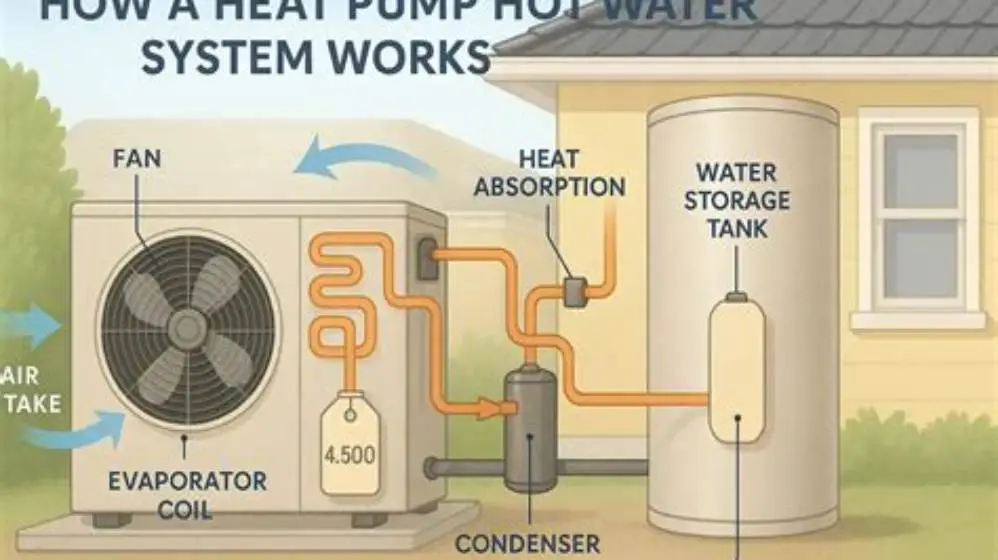
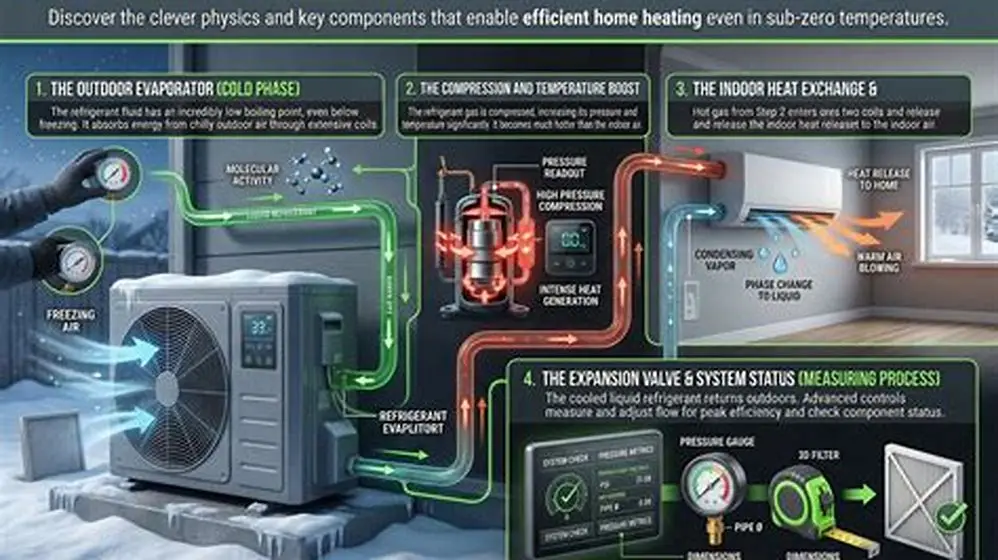
A heat pump runs a closed refrigeration loop in four stages: evaporation, compression, condensation and expansion. Start at the evaporator. Low-pressure liquid refrigerant absorbs heat from outdoor air and evaporates into a gas near -10°C to -15°C. The cold gas then goes to the compressor. The compressor raises pressure to about 15 to 25 bar and temperature to 60°C to 80°C. Hot gas enters the indoor condenser and gives off heat to water or air, condensing at roughly 40°C to 50°C. The liquid then passes an expansion valve. That valve cuts pressure and the temperature falls back toward -20°C to restart evaporation. We go through how heat pump hot water system works step by step elsewhere on the site.
Coefficient of performance (COP) is heat out divided by electrical input. A COP of 3.0 gives 3 kW heat per 1 kW electricity. COP drops as outdoor temperature falls because the compressor must lift refrigerant from a colder start. Refrigerant choice sets the pressure-temperature curve and the evaporator operating point. Modern refrigerants like R32 or R290 allow usable heat extraction to lower outdoor temperatures than older refrigerants.
- Evaporation: Liquid refrigerant at low pressure and
-20°Cabsorbs heat outdoors and vaporises. - Compression: Compressor raises pressure to
15–25 bar, lifting temperature to60–80°C. - Condensation: Indoor coil releases heat and condenses the gas to liquid at
40–50°C. - Expansion: Valve lowers pressure and temperature, returning refrigerant toward
-20°C.
Key heat pump components involved in heat absorption
The evaporator coil is the heat entry point. It is a finned aluminium or copper heat exchanger with about 2–4 m² of surface in domestic units. Fin spacing balances surface area and frost risk. Hydrophilic-coated fins shed moisture faster and cut frost build-up.
The expansion valve sets evaporator pressure and boiling point. TXV or EEV types control flow to match conditions. Electronic valves offer finer control and can raise seasonal COP by about 0.1–0.2. For the detail, see our notes on heat pump retrofit planning and compatibility.
The compressor pumps refrigerant from low to high pressure. Many domestic units use inverter-driven scroll compressors. Cold-climate models add vapour-injection or two-stage compression to keep capacity at -15°C and below.
The outdoor fan moves air through the evaporator. Variable-speed fans use more power when needed but keep heat capture higher in cold air. Leave at least 500 mm clearance on the intake side; a metre is better.
- Evaporator coil: finned exchanger, typically
2–4 m², where refrigerant evaporates and absorbs heat. - Expansion valve (TXV or EEV): throttles flow to control evaporator pressure and boiling point.
- Compressor (scroll or vapour-injection): raises refrigerant pressure and temperature.
- Variable-speed fan: increases airflow in cold conditions to maintain heat transfer.
Why heat extraction works efficiently to minus fifteen degrees
Efficiency is governed by the Carnot limit, a thermodynamic ceiling that says the maximum possible COP is the ratio of absolute temperatures: (indoor temp in kelvin) ÷ (indoor temp − outdoor temp). For a 20°C room heated from -5°C air, the Carnot COP is 293 ÷ 25 = 11.7. Real heat pumps achieve 40 to 60 per cent of the Carnot limit due to friction, heat losses and imperfect heat exchange, so a real-world COP of 2.5 to 3.0 at -5°C is typical for a well-designed system. As outdoor temperature falls, the denominator grows and the Carnot limit drops: at -15°C the theoretical maximum falls to 293 ÷ 35 = 8.4, and real COP drops to 1.8 to 2.2. We go through when retubing is necessary step by step elsewhere on the site.
Below -15°C, most UK air-source heat pumps see rapidly diminishing returns. Refrigerant pressure in the evaporator falls so low that compressor displacement becomes a bottleneck, and the gap between refrigerant boiling point and outdoor air narrows to a few degrees. To extract the same kilowatts of heat, the pump must move much more air through the coil or run continuously. Defrost cycles become more frequent, consuming 10 to 15 per cent of gross output. At -20°C, a standard single-stage pump may deliver only half its rated capacity at 7°C, and COP can fall below 2.0. Cold-climate models with vapour injection maintain COP above 2.0 down to -25°C, but they cost £1,500 to £3,000 more and make sense only in Scottish highlands or exposed northern sites that regularly see those extremes.
The sweet spot for air-source heat pumps in the UK is 0°C to -10°C, the band that covers the vast majority of heating degree-days. A pump sized for this range delivers a seasonal COP (SCOP) of 2.8 to 3.5 across an average heating season, depending on insulation, flow temperature and installation quality. Push it to -15°C and seasonal efficiency still holds up, but size the system for peak demand at -5°C rather than a once-a-decade freeze, and accept that a backup immersion or gas boiler tops up on the coldest nights. Oversizing the heat pump to cover -15°C without backup wastes money: the extra capacity sits idle 98 per cent of the year and the larger compressor reduces part-load efficiency in mild weather.
| Outdoor temp | Typical COP | Capacity vs 7°C | Defrost frequency |
|---|---|---|---|
7°C | 3.5–4.0 | 100% | Rare |
0°C | 2.8–3.2 | 90–95% | Every 60–90 min |
-5°C | 2.3–2.7 | 75–85% | Every 30–60 min |
-10°C | 1.9–2.3 | 60–75% | Every 20–40 min |
-15°C | 1.6–2.0 | 50–65% | Every 15–30 min |
What happens when outdoor temperature drops below design limits
When outdoor air falls below the pump's rated lower limit, performance drops. Many standard air-source units use -15°C as a practical lower limit. The compressor then runs near full speed while the evaporator struggles to absorb heat. Defrost cycles increase. The unit may spend long periods defrosting and lose net heat delivery. There is more on spray foam insulation in loft sagging after a year in a separate guide.
COP can fall to 1.5 or lower on very cold days. Controllers switch to bivalent mode or start backup heat at a set threshold, often between -5°C and -10°C. Backup sources include a 3 kW immersion heater, a gas boiler or electric radiators. Design for the temperature you get most of the time. A 3 kW immersion typically runs 30–50 hours a year in UK winters and adds about £15–£25 to the annual bill.
Questions people still ask
Can a heat pump extract heat from air below freezing?
Yes. Refrigerant evaporates at -20°C to -30°C, so air at 0°C or even -10°C is warm enough to transfer heat into the coil. The refrigerant absorbs that energy, evaporates, and the compressor raises its temperature to 50–65°C for heating. Efficiency falls as outdoor temperature drops, but extraction continues down to -15°C or lower in most UK air-source heat pumps.
What is the coldest outdoor temperature a heat pump can work at?
Standard UK air-source heat pumps operate efficiently down to -10°C and continue extracting heat to -15°C, though COP falls to 1.8–2.0. Cold-climate models with vapour-injection compressors work to -25°C or beyond. Below those limits, backup heating is more cost-effective than running the heat pump alone.
Why does frost form on the outdoor unit?
The evaporator coil surface drops below 0°C as refrigerant evaporates inside it. Moisture in the air condenses on the cold fins and freezes. Heat pumps include a defrost cycle that briefly reverses refrigerant flow, melting the ice. Defrost cycles are normal and occur more often when outdoor temperature is near freezing and humidity is high.
Does a heat pump use more electricity when it is colder outside?
Yes. The compressor must work harder to raise refrigerant temperature from a lower starting point, and heat output per kilowatt of electricity falls. At -10°C, COP typically drops to 2.0–2.3, compared to 3.0–3.5 at 7°C. Total electricity use rises both because efficiency falls and because your home loses more heat to the cold outdoors, demanding higher output.
Is a heat pump better than a gas boiler in very cold weather?
It depends on COP and fuel prices. At -5°C, a heat pump with COP 2.5 costs roughly the same per kilowatt-hour of heat as a gas boiler at 90 per cent efficiency, given typical UK electricity and gas rates. Below -10°C, COP falls toward 2.0 and gas becomes cheaper per unit of heat. But across a full heating season, the heat pump spends most of its time at higher COP, so seasonal cost is lower.