Calculate the required constructed wetland area for a 4-bedroom house using UK wastewater flow rates and design parameters.
A constructed wetland for a 4-bedroom house typically needs between 24 and 40 square metres of surface area. This depends on wastewater flow assumptions, usually 150-200 litres per person per day, and treatment performance factors.
On this page
- The short version
- How to calculate wastewater flow for a 4-bedroom house
- The area per person or bedroom needed for wetland treatment
- UK regulations and typical design parameters for constructed wetlands
- Examples of sizing calculations for domestic constructed wetland systems
- What reduces constructed wetland treatment performance
- How to size a constructed wetland for a 4-bedroom house
- Questions people still ask
Part of our guide on low flow high pressure pump
| Wastewater flow | 600-800 L/day |
|---|---|
| Area per person | 6-10 m² |
| Typical wetland size | 24-40 m² |
| Occupants assumed | 4-6 people |
| Hydraulic loading | 20-40 mm/day |
The short version
- Estimate wastewater flow as 150-200 litres per person daily.
- Design wetland area at 6-10 square metres per person for treatment.
- UK rules suggest 24-40 m² for a 4-bedroom house.
- Wetland performance falls with high hydraulic loading or poor maintenance.
- Proper sizing cuts drainage costs and improves wastewater quality.
How to calculate wastewater flow for a 4-bedroom house
Wastewater flow depends on household size and water use. For a 4-bedroom house, assume 4-6 occupants. UK typical water use ranges from 150 to 200 litres per person per day.
Multiply occupants by per capita flow to get daily wastewater volume. For 5 people, this equals roughly 750 litres daily (5 x 150 L). This volume forms the basis of wetland sizing.
Seasonal variations and water-saving fixtures affect flow rates. For practical sizing, design for the higher end of flow, around 800 litres per day, to avoid undersizing.
This flow estimate informs hydraulic loading and wetland surface area calculations. Before you commit to anything, it is worth looking at low flow toilet running.
Using water-efficient fixtures can reduce daily flow to about 120 litres per person, lowering the wetland size needed. For example, 5 occupants × 120 L = 600 litres daily. This smaller volume reduces surface area by up to 20%, saving space and cost.
High occupancy spikes during events can temporarily double flow. Designing with a 25% safety margin covers such spikes. If daily flow is 750 L, size for about 940 L to handle peak loads without flooding or treatment failure. This margin avoids system stress.
The area per person or bedroom needed for wetland treatment
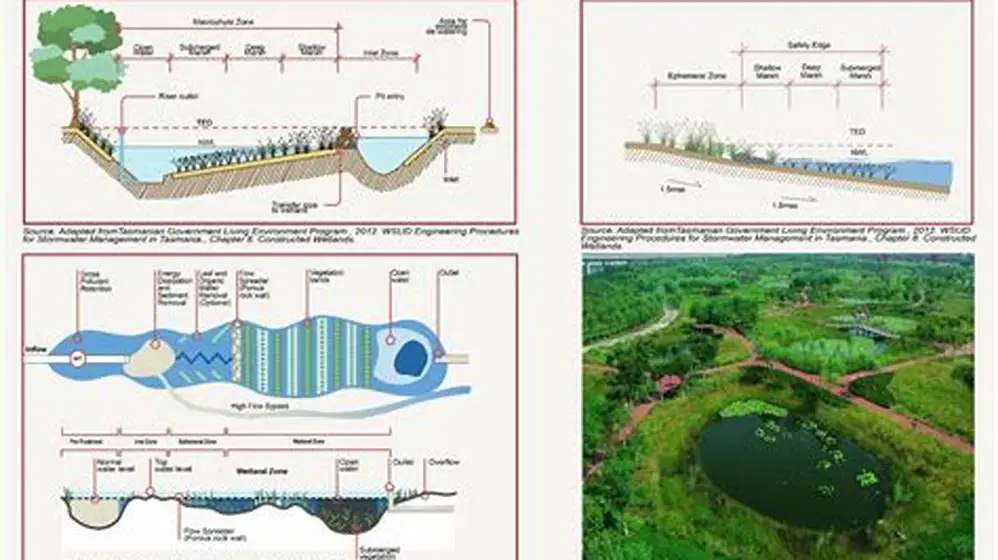
Constructed wetlands treat wastewater by filtering it through plants and substrate. The treatment area per person usually ranges from 6 to 10 square metres of surface area. People in this spot often ask about uk rainwater harvesting costs as well.
This range depends on influent water quality, wetland design, and desired treatment level. More area means better treatment but higher costs and space.
For a 4-bedroom house with 4-6 people, the minimum wetland area ranges from 24 to 60 square metres. UK designs commonly use 6-8 m² per person.
Sizing by bedroom count is less precise than by occupant number, but usually each bedroom adds roughly 1.5 people to account for visitors. For the detail, see our notes on what counts as ultra low flow shower head flow.
Wetland area requirements also depend on wastewater strength. Stronger sewage with higher BOD needs more surface area for effective treatment. For example, if influent BOD doubles, increase area per person from 6 to 10 m² to maintain effluent quality.
Plant species affect treatment efficiency. Cattails and reeds improve oxygen transfer, reducing area needs by 10-15%. Using these plants can lower a 30 m² design to about 26-27 m² without losing performance.
UK regulations and typical design parameters for constructed wetlands
UK regulations require that constructed wetlands meet effluent quality standards and protect groundwater. The Environment Agency sets limits on biochemical oxygen demand (BOD) and suspended solids. We go through low pressure pump for garden step by step elsewhere on the site.
Typical UK design uses hydraulic loading rates of 20-40 millimetres per day to optimise treatment and avoid overload. This means the wetland must handle daily flow spread over its surface area accordingly.
Depth of the wetland is usually 0.5 to 1 metre, depending on substrate and plant species. Slower flow rates improve treatment but increase footprint.
Failing to meet hydraulic loading or overloading with high flow reduces performance and risks pollution.
UK regulations also require setback distances from watercourses and property boundaries. Typically, wetlands must be at least 10 metres from wells and 5 metres from boundaries, affecting site layout and feasible wetland size.
Hydraulic loading rates vary by substrate permeability. Gravel substrates allow 40 mm/day load, while finer soils require 20-25 mm/day. Selecting a well-draining substrate helps keep the wetland footprint smaller.
Regular sampling of effluent for BOD and total suspended solids confirms compliance. Analytical checks every 6 months help spot performance drops early, allowing corrective action before risking pollution.
Examples of sizing calculations for domestic constructed wetland systems
Calculate daily wastewater volume: 5 occupants × 150 L/day = 750 L/day. Use the hydraulic loading rate to find area.
Assuming 30 mm/day hydraulic loading, divide 750 litres by 30 mm (0.03 m): 750 ÷ 0.03 = 25,000 litres/m² or 25 m² surface area needed.
Using area per person: 5 × 6 m² = 30 m² minimum wetland area.
In practice, pick the larger area requirement for design safety. Here, 30 m² suits a typical 4-bedroom house.
Adjustments include increased area for poor soil drainage or colder climates.
Example: For 6 occupants using 200 L/day, total flow is 1,200 L/day. At 30 mm/day hydraulic loading, required area = 1,200 ÷ 0.03 = 40 m². This is larger than 6 × 6 = 36 m² from per person area, so pick 40 m².
In colder northern UK areas, reduce hydraulic loading to 20 mm/day to compensate for slower microbial action. For the same 1,200 L flow, area = 1,200 ÷ 0.02 = 60 m², significantly larger than standard designs.
If the site has poor drainage, increase wetland area by 25% to avoid flooding. For the 40 m² example, increase to 50 m², ensuring water spreads evenly and treats effectively.
| Method | Calculation | Result |
|---|---|---|
| Wastewater volume & hydraulic loading | 750 L/day ÷ 0.03 m | 25 m² |
| Area per person | 5 × 6 m² | 30 m² |
What reduces constructed wetland treatment performance
Excessive hydraulic loading above 40 mm/day reduces oxygen transfer and filtration, harming treatment. Keep flow rates within design limits.
Cold UK winters slow microbial action in the wetland, lowering treatment efficiency. Larger surface areas help compensate.
Neglected maintenance, such as clogged inlet pipes or overgrown vegetation, reduces flow uniformity and filtering effectiveness.
Improper wastewater pre-treatment or high grease and solids can overload the system quickly.
How to size a constructed wetland for a 4-bedroom house
Start by estimating occupants: a 4-bedroom house usually houses 4-6 people. Use 150-200 litres daily wastewater flow per person to calculate total flow.
Pick a hydraulic loading rate between 20 and 40 millimetres per day depending on soil and climate conditions.
Divide daily wastewater volume by hydraulic loading depth to find wetland surface area.
Alternatively, multiply occupants by 6-10 m² to estimate area directly.
Choose the larger area result from these methods to allow treatment margins and seasonal fluctuations.
Make sure the wetland depth is between 0.5 and 1 metre, and include access for maintenance.
Regularly test flow rates and effluent quality with a simple water quality test kit to ensure system function.
- Estimate number of occupants (usually 4-6 for 4-bedroom house).
- Calculate daily wastewater flow: occupants × 150-200 L/person/day.
- Select hydraulic loading rate (20-40 mm/day).
- Calculate wetland area: total flow ÷ hydraulic loading.
- Or multiply occupants by 6-10 m² to get area.
- Pick larger calculated wetland area.
- Plan wetland depth (0.5-1 m) and maintenance access.
- Use water quality test kit to monitor system.
Questions people still ask
Can I size a constructed wetland by bedroom number alone?
Bedroom count is a rough proxy for occupants but varies by household. It’s better to estimate actual people and their water use to size wetlands accurately.
What happens if the wetland is too small?
Undersized wetlands overload, reduce treatment efficiency, and may fail to meet UK effluent standards, risking pollution and fines.
Are constructed wetlands suitable for cold UK climates?
Yes, but cold slows treatment. Design larger surface areas and maintain vegetation to compensate.
How often should I test effluent quality?
Test at least twice yearly, more if problems arise, to ensure the wetland meets required standards.
Do all constructed wetlands need the same area?
No. Area depends on flow, hydraulic loading, soil, and climate – not just house size.