R value measures how well insulation resists heat flow. Higher numbers mean better performance, and the metric unit is m²·K/W.
R value measures thermal resistance in insulation. The higher the number, the slower heat escapes. The metric unit is m²·K/W (square metres kelvin per watt), and UK loft insulation typically ranges from 3.5 to 7 m²·K/W depending on thickness and material.
On this page
Part of our guide on what is a green home
R value tells you how slowly heat leaks through insulation, and a difference of two points can halve your heat loss.
| Metric unit | m²·K/W |
|---|---|
| Imperial unit | ft²·°F·hr/BTU |
| UK loft target | 6.0 to 7.0 m²·K/W |
| 150 mm mineral wool | ≈ 3.75 m²·K/W |
| 270 mm mineral wool | ≈ 6.75 m²·K/W |
| PIR board 100 mm | ≈ 4.5 m²·K/W |
The short version
- R value measures thermal resistance: higher numbers mean better insulation and slower heat loss
- Metric units are m²·K/W; imperial units are ft²·°F·hr/BTU (multiply metric by 5.68 to convert)
- UK loft insulation typically sits between 3.5 and 7 m²·K/W for 150 to 270 mm mineral wool
- Double the thickness and you roughly double the R value for the same material
- Check product labels for declared R value rather than relying on thickness alone
What R value means for insulation
R value is the measure of how well a material resists the flow of heat. It tells you how slowly warmth leaks out of your house through that material. The bigger the R value, the better the insulation performance. A wall with an R value of 6 m²·K/W loses half the heat of one rated at 3 m²·K/W under the same temperature difference.
The R stands for resistance. You can think of it as thermal resistance the way an electrician thinks of electrical resistance. More resistance means less flow. In insulation, less heat flow means lower energy bills and a warmer home in winter.
R value combines two things: the material's intrinsic ability to resist heat (its thermal conductivity, written as λ or lambda) and its thickness. A thick layer of mediocre insulation can outperform a thin layer of premium foam simply because there is more of it. That is why R value is more useful than thermal conductivity alone when you are comparing installed products.
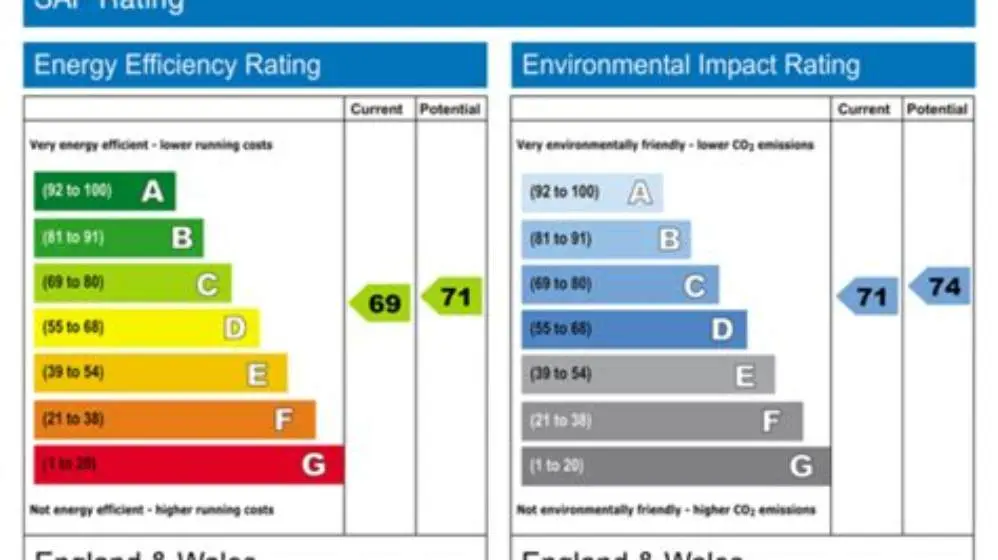
Every insulation product sold in the UK must declare its thermal resistance. You will find it on the label as R with a number and the unit m²·K/W. That declaration accounts for the actual thickness supplied, so you can compare products directly without doing the arithmetic yourself. If that sounds like your situation, read up on what is sap rating next.
How R value measures thermal resistance
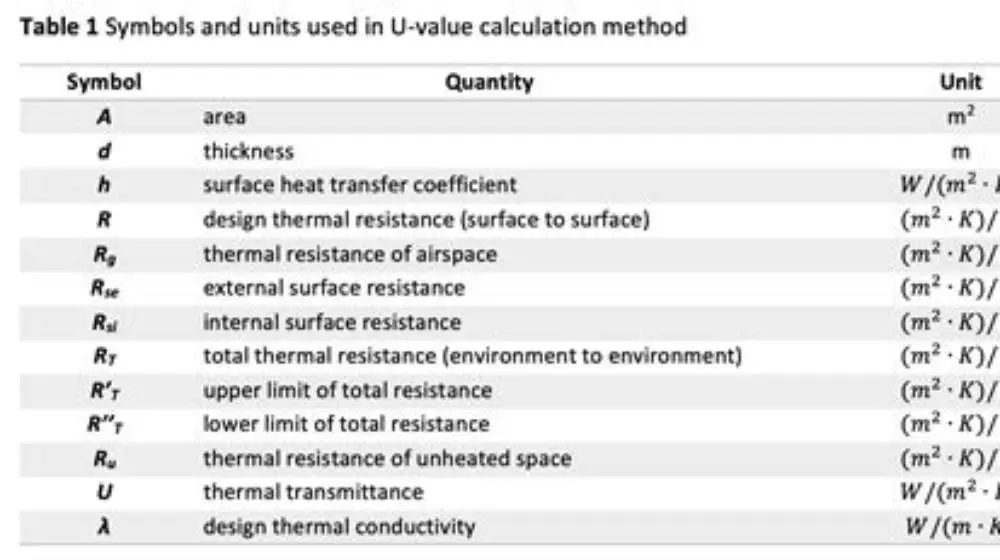
Thermal resistance quantifies how much of a barrier a material presents to heat trying to pass through it. The formula is straightforward: R = thickness ÷ thermal conductivity. Thickness is in metres, and thermal conductivity (lambda, λ) is in watts per metre kelvin, or W/m·K. The resulting R value comes out in m²·K/W.
A material with low thermal conductivity is a good insulator. Mineral wool typically has a lambda around 0.040 W/m·K, while PIR foam board sits closer to 0.022 W/m·K. Lower lambda means better performance per millimetre. If you install 0.15 m (150 mm) of mineral wool with a lambda of 0.040, the R value is 0.15 ÷ 0.040 = 3.75 m²·K/W.
R value scales linearly with thickness for the same material. Double the depth and you double the R value, assuming the material does not compress or change properties. That linearity makes it easy to estimate the benefit of adding another layer. If 100 mm gives you 2.5, then 200 mm will give you 5.0. There is more on u-value in construction in a separate guide.
The test method for declaring R value is standardised under BS EN 12667 and BS EN 12939. Manufacturers measure heat flow through a sample held between hot and cold plates, then calculate the resistance. The declared value includes a safety margin, so the real-world performance should meet or exceed the label.

Dasqua 12”/300mm Digital Caliper
Measures insulation thickness accurately with 300 mm reach and ±0.02 mm accuracy, ensuring precise verification of R value.
Units used for R value
The metric unit is m²·K/W, read as square metres kelvin per watt. It tells you the temperature difference in kelvins (which is the same as degrees Celsius for a difference) needed to push one watt of heat through one square metre of the material. A higher number means you need a bigger temperature difference to get the same heat flow, which is another way of saying the insulation is better.
The imperial unit is ft²·°F·hr/BTU, read as square feet degree Fahrenheit hour per British thermal unit. You will see this on American datasheets and in older UK literature. To convert from metric to imperial, multiply the metric R value by 5.68. An insulation rated 4.0 m²·K/W in metric is roughly 22.7 ft²·°F·hr/BTU in imperial. Before you commit to anything, it is worth looking at carbon impact of material production.
UK building regulations, product labels and Energy Performance Certificate (EPC) assessments all work in metric. You will rarely need the imperial figure unless you are comparing a product imported from the US or working from an old specification. Even then, most suppliers now print both units on the same label.
Some datasheets quote thermal conductivity (λ) instead of R value, especially for raw materials sold by the cubic metre. If you only have lambda and thickness, divide thickness in metres by lambda in W/m·K to get R in m²·K/W. A 200 mm slab with lambda 0.035 gives R = 0.20 ÷ 0.035 = 5.71 m²·K/W.
| Metric R value | Imperial R value | Conversion |
|---|---|---|
| 1.0 m²·K/W | 5.68 ft²·°F·hr/BTU | Metric × 5.68 |
| 3.5 m²·K/W | 19.9 ft²·°F·hr/BTU | Metric × 5.68 |
| 6.0 m²·K/W | 34.1 ft²·°F·hr/BTU | Metric × 5.68 |
Typical R values for common insulation materials in UK homes
Mineral wool (glass or rock) is the most common loft insulation. A 150 mm roll of standard mineral wool delivers around 3.5 to 3.75 m²·K/W, depending on density and lambda. At 270 mm thickness, which is the current recommended depth for lofts, you get 6.5 to 7.0 m²·K/W. Lambda for mineral wool typically ranges from 0.035 to 0.044 W/m·K. The other half of this decision is what is breeam.
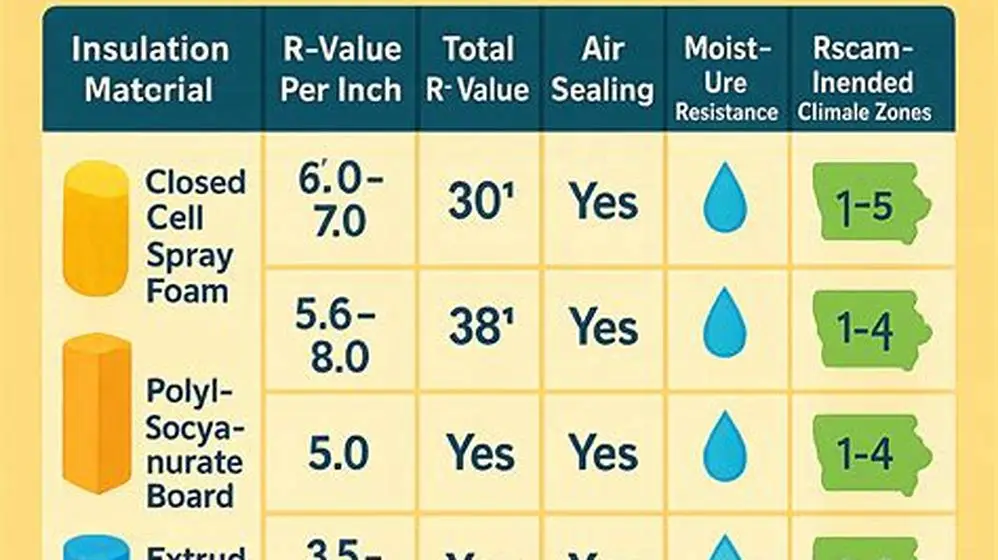
PIR (polyisocyanurate) foam board has a lower lambda, usually 0.022 to 0.025 W/m·K, so you get more R value per millimetre. A 100 mm PIR board gives roughly 4.0 to 4.5 m²·K/W. That makes it popular for internal wall insulation and flat roofs where space is tight. A 50 mm board delivers about 2.0 to 2.25 m²·K/W, enough to improve an uninsulated wall significantly.
EPS (expanded polystyrene) sits between mineral wool and PIR, with lambda around 0.030 to 0.038 W/m·K. A 100 mm slab yields 2.6 to 3.3 m²·K/W. It is lighter and cheaper than PIR but thicker for the same performance. You will find it in external wall insulation systems and under concrete floor slabs.
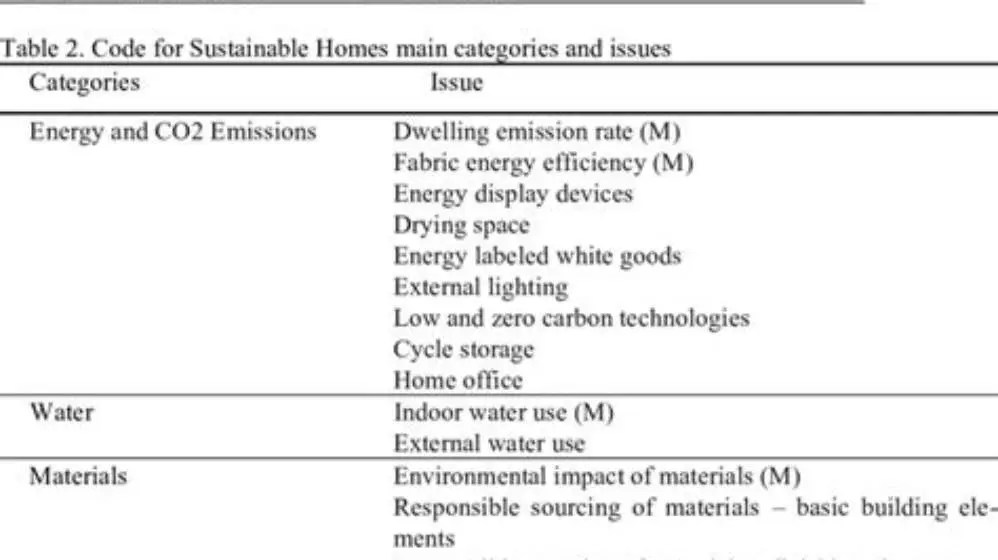
Sheep's wool and wood fibre are natural alternatives with lambda similar to mineral wool, around 0.038 to 0.040 W/m·K. A 150 mm batt of sheep's wool gives approximately 3.75 m²·K/W. Performance is comparable, but cost per square metre is higher. Multifoil reflective insulation is thinner, often 20 to 40 mm, but declared R values are lower than rigid boards, typically 1.0 to 2.5 m²·K/W depending on how it is installed and whether air gaps are included. For the detail, see our notes on what was the code for sustainable homes.
Cavity wall insulation is usually blown mineral wool, EPS beads or foam. A standard 100 mm cavity filled with blown mineral wool adds around 2.5 m²·K/W to the wall. The existing brick and blockwork contribute another 0.5 to 0.8 m²·K/W combined, giving a total wall R value of roughly 3.0 to 3.5 m²·K/W once insulated.
| Material | Thickness | Approx. R value | Lambda (W/m·K) |
|---|---|---|---|
| Mineral wool | 150 mm | 3.5–3.75 m²·K/W | 0.035–0.044 |
| Mineral wool | 270 mm | 6.5–7.0 m²·K/W | 0.035–0.044 |
| PIR foam board | 50 mm | 2.0–2.25 m²·K/W | 0.022–0.025 |
| PIR foam board | 100 mm | 4.0–4.5 m²·K/W | 0.022–0.025 |
| EPS board | 100 mm | 2.6–3.3 m²·K/W | 0.030–0.038 |
| Sheep's wool | 150 mm | 3.75 m²·K/W | 0.038–0.040 |
What higher or lower R values mean in practice
A higher R value means slower heat loss and lower heating bills. If you double the R value of your loft insulation from 3.5 to 7.0 m²·K/W, you halve the rate at which heat escapes through the roof. That does not halve your total energy bill, because floors, walls and windows also lose heat, but loft heat loss typically accounts for 20 to 25 per cent of the total in an uninsulated home. Doubling loft R value can cut that portion by half, saving roughly 10 to 12 per cent on the whole heating bill.
The current UK target for loft insulation is an R value of at least 6.0 m²·K/W, which corresponds to around 270 mm of mineral wool. Older homes with 100 mm of loft insulation sit around 2.5 m²·K/W and lose more than twice as much heat. Adding another 170 mm on top brings the total to 6.5 and cuts loft heat loss by more than half.
For walls, Building Regulations Part L (2021 edition) requires new-build walls to achieve a U value of 0.18 W/m²·K or better, which equates to a total R value of at least 5.6 m²·K/W for the whole wall assembly. An uninsulated cavity wall has a U value around 1.5 W/m²·K (R = 0.67), so filling the cavity and adding internal or external insulation is essential to meet modern standards.
Lower R values are acceptable in floors, especially solid ground floors, because the temperature difference between inside and the ground is smaller than between inside and outside air. Part L asks for a floor U value of 0.18 W/m²·K (R = 5.6) in new builds, but retrofit guidance is more relaxed. Adding 50 to 75 mm of PIR under a new screed (R = 2.0 to 3.0) makes a noticeable difference in comfort and running cost.
How to compare products using R value
R value lets you compare different materials and thicknesses on an equal footing. If one supplier offers 200 mm mineral wool at R = 5.0 and another offers 120 mm PIR at R = 5.0, both will insulate the same amount. The choice then comes down to cost, ease of fitting and how much space you can spare. PIR costs more per square metre but takes up less room, so it wins in a shallow roof or a tight cavity.
Always read the declared value on the product label rather than calculating from thickness alone. Manufacturing tolerances, density variations and compression during packing can all affect real-world performance. A reputable manufacturer tests batches and declares a conservative R value that accounts for those factors.
When topping up existing insulation, add the new R value to the old. If you have 100 mm of old mineral wool (R ≈ 2.5) and you lay 170 mm of new roll (R ≈ 4.25) across it, the total is 6.75 m²·K/W. Lay the new roll perpendicular to the old to cover gaps and timber joists, which act as thermal bridges.
Check whether the R value on the label includes any air gap. Some multifoil products quote higher R values when installed with a ventilated air space on one or both sides. If you cannot provide that air gap, the performance drops. Rigid boards and batts do not rely on air gaps, so their R values are straightforward.
For a quick field check, measure the thickness in millimetres and look up the typical lambda for that material type. Divide thickness (in metres) by lambda to estimate R value. A digital calliper or steel tape measure gives you the thickness, and the product datasheet or manufacturer's website gives you lambda. If your calculated R is much lower than the label, the insulation may have compressed or degraded.
Questions people still ask
Is a higher R value always better?
Yes, a higher R value means better thermal resistance and lower heat loss. But there is a point of diminishing returns. Going from R = 2 to R = 4 halves your heat loss; going from R = 6 to R = 8 cuts it by a quarter. The second upgrade saves less money, so you balance cost against benefit.
Can I add different insulation types together?
Yes. If you install PIR board on top of mineral wool, or add a new layer of a different material, you add the R values. A 50 mm PIR board (R = 2.25) on top of 100 mm mineral wool (R = 2.5) gives a total of 4.75 m²·K/W.
Why do some products list lambda instead of R value?
Lambda (thermal conductivity) describes the material alone, not a specific thickness. Manufacturers give lambda when they sell material by the cubic metre or in custom thicknesses. You calculate R by dividing thickness in metres by lambda in W/m·K.
Does R value change over time?
Most insulation holds its R value for decades. Mineral wool and EPS are stable. PIR and polyurethane foam can lose a little performance over the first few years as blowing agents diffuse out, but manufacturers account for that in the declared value. Wet or compressed insulation performs worse.
What R value do I need to meet Building Regulations?
Part L does not specify R directly; it sets U value limits for walls, roofs and floors. For new-build roofs, U must be 0.11 to 0.15 W/m²·K, which translates to a total assembly R of roughly 6.7 to 9.1 m²·K/W including plasterboard, timber and tiles.